
In the heart of Thailand, a groundbreaking study is unraveling the genetic secrets of teak (Tectona grandis), a tropical tree species prized for its high-quality heartwood and adaptability. The research, led by Naoki Tani from the Japan International Research Center for Agricultural Sciences (JIRCAS), and published in ‘Forest Science and Technology’, delves into the heritability of key traits such as growth characteristics and heartwood formation, offering promising insights for the agriculture and forestry sectors.
Teak, a valuable timber species, has long been cultivated for its excellent wood quality. However, understanding the genetic underpinnings of its traits is crucial for designing effective breeding programs aimed at improving wood quality and productivity. The study assessed the heritability of various traits, including stem diameter, stem height, heartwood width, and sapwood depth, using 538 stems from a clonal trial in Thailand.
The researchers constructed additive (GA) and dominant (GD) genetic relationship matrices using single-nucleotide polymorphisms derived from MIG-seq. The results revealed that heritability estimates based on GA were generally higher than those based on GD, indicating the predominant role of additive genetic variance in most traits. This finding is significant as it suggests that selective breeding could be highly effective in improving these traits.
“Our findings highlight the importance of accounting for trait-specific genetic architecture in teak breeding strategies,” said Naoki Tani, the lead author of the study. “This is particularly relevant for traits such as sapwood depth, where non-additive effects may play a significant role.”
One of the most notable findings was the equivalent heritability of sapwood depth in both matrices, underscoring the potential significance of non-additive genetic effects. This insight could revolutionize breeding programs by emphasizing the importance of allelic combinations in achieving desired traits.
The study also found that both stem diameter and height heritabilities decreased with age, likely reflecting a shift in genetic control during maturation. Heartwood width exhibited moderate heritability (16–22%), which was influenced by the low heritability of stem diameter. In contrast, higher heritability in both additive and dominance effects for sapwood depth was detected, evoking the importance of allelic combination.
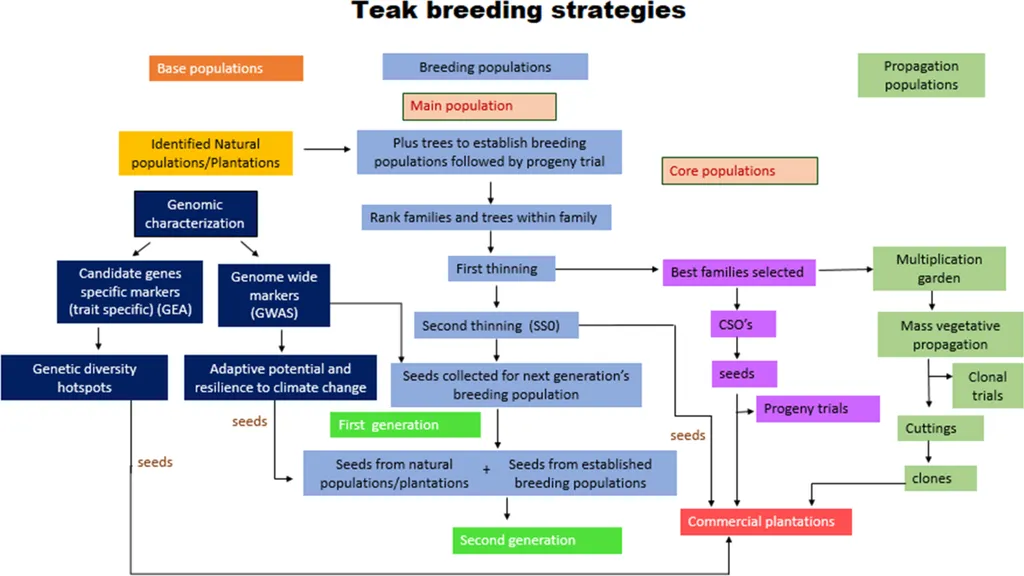
The commercial implications of this research are substantial. By understanding the genetic basis of growth and wood formation in teak, breeders can develop more efficient and targeted breeding programs. This could lead to the cultivation of teak trees with superior wood quality and productivity, ultimately benefiting the agriculture and forestry sectors.
The study provides critical insights into the genetic architecture of teak, paving the way for optimized genetic improvement programs. As the global demand for high-quality timber continues to grow, this research offers a promising path forward for sustainable and efficient teak cultivation.
In the words of Naoki Tani, “This research not only advances our understanding of teak genetics but also opens new avenues for improving the quality and yield of this valuable timber species.” With these insights, the future of teak cultivation looks brighter than ever, offering significant benefits for the agriculture sector and beyond.