
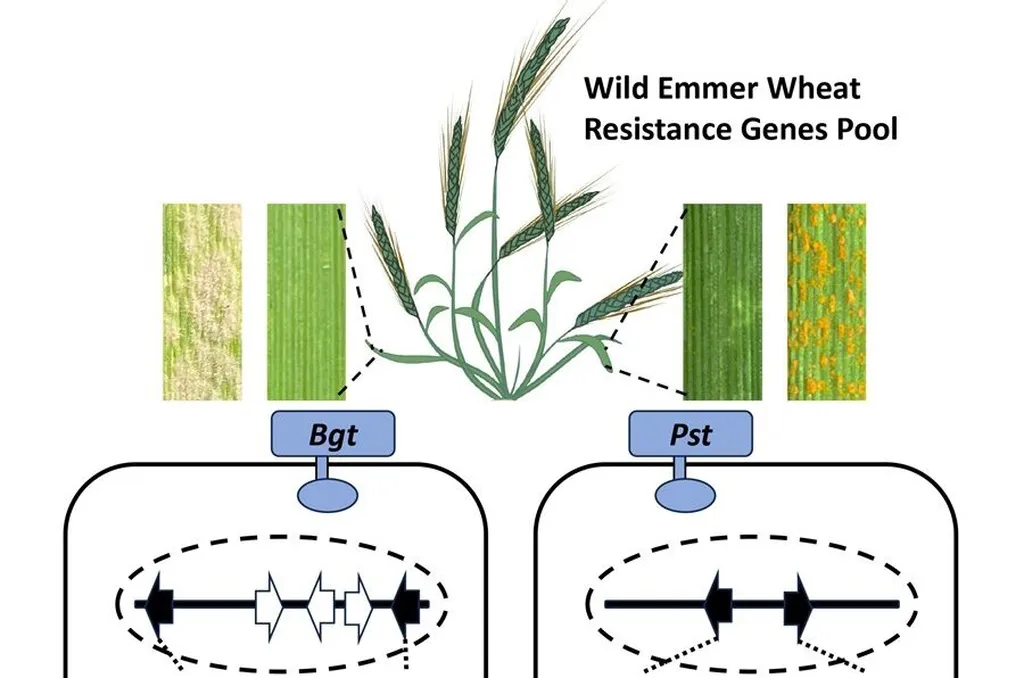
In the relentless pursuit of securing global food supplies, scientists have long sought to fortify wheat—one of the world’s most vital crops—against the onslaught of diseases that threaten its yield. A recent breakthrough, published in *Advanced Science*, offers a promising avenue for enhancing wheat’s resistance to multiple foliar diseases, potentially revolutionizing agricultural practices and crop breeding strategies.
Researchers, led by Wenling Li at the Institute of Biotechnology Xianghu Laboratory in Hangzhou, China, have identified and cloned a gene, WAI-B2, that confers broad-spectrum resistance to wheat. This gene encodes a unique transmembrane protein that has shown efficacy against powdery mildew, stripe rust, leaf rust, and stem rust—some of the most devastating pathogens affecting wheat crops.
The discovery of WAI-B2 is significant not only for its immediate implications but also for the innovative methods employed in its development. By leveraging AI tools like AlphaFold 2 and SWISS-MODEL, the team was able to predict optimal amino acid substitutions and hydrogen bond interaction sites, leading to the design of new WAI-B2 alleles. These alleles were then tested for their ability to induce mild cell death in *Nicotiana benthamiana*, a model plant often used in such studies.
“This research opens up new possibilities for designing disease-resistant crops using AI-assisted approaches,” said Li. “By understanding the molecular mechanisms behind autoimmunity and disease resistance, we can develop more robust wheat varieties that are less susceptible to multiple pathogens.”
The commercial impact of this research could be profound. Wheat is a staple crop for billions of people worldwide, and diseases like rust and powdery mildew can cause significant yield losses, leading to economic hardships for farmers and food insecurity in vulnerable regions. The development of wheat varieties with broad-spectrum resistance could mitigate these risks, ensuring more stable and predictable harvests.
Moreover, the use of AI in crop design represents a paradigm shift in agricultural biotechnology. Traditional breeding methods are time-consuming and often limited in their scope. AI, on the other hand, allows for rapid and precise modifications, accelerating the development of crops with desired traits.
“This is just the beginning,” Li added. “As we continue to refine our understanding of plant immunity and the role of transmembrane proteins, we can expect to see even more innovative solutions for crop protection.”
The implications of this research extend beyond wheat. The principles and techniques demonstrated in this study could be applied to other crops, paving the way for a new era of disease-resistant agriculture. As the global population continues to grow, the need for resilient and high-yielding crops will only increase, making breakthroughs like this all the more critical.
In summary, the identification and characterization of the WAI-B2 gene represent a significant step forward in the quest for disease-resistant wheat. By combining traditional plant biology with cutting-edge AI technologies, researchers have unlocked new possibilities for crop improvement, offering hope for a more secure and sustainable agricultural future.