
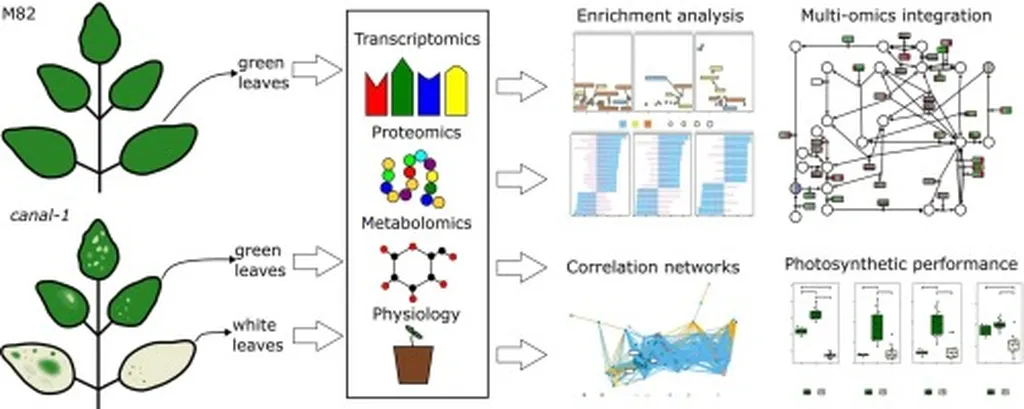
In the world of plant science, understanding photosynthesis is akin to deciphering a complex code that fuels life on Earth. A recent study published in *Industrial Crops and Products* has taken a significant step forward in this endeavor, particularly in the realm of variegated leaves. Led by Zhen-Xing Wang from the Laboratory of Wild Fruit Physiology at Jilin Agricultural University, the research aims to resolve inconsistencies in measuring the photosynthetic capacity of variegated leaves, offering potential commercial impacts for the agriculture sector.
Variegated leaves, with their striking patterns of white, yellow, or pale green, have long fascinated botanists and horticulturists alike. However, their photosynthetic performance has been a subject of debate. Traditional methods of measuring photosynthesis, such as CO₂ assimilation and chlorophyll fluorescence, have often yielded inconsistent results when applied to variegated leaves. This inconsistency, according to Wang and his team, stems from inaccuracies in estimating the absorptance by photosynthetic pigments and the maximum fluorescence yield under light (Fm’).
To address these inaccuracies, the researchers developed a simple two-layer model to quantify the absorptance by photosynthetic pigments. They also applied an inverse relation between fluorescence intensity and saturating light pulse intensity to obtain a more reliable Fm’. The results were striking. The actual chlorophyll absorptance of eight variegated leaf species varied significantly, ranging from 28.62% to 80.31% in white light. Moreover, the conventional method underestimated Fm’ by 4.42% to 10.42%.
These corrections led to a profound realization: the electron transport rate through Photosystem II (ETR2) for the studied species was overestimated by the conventional method, with variations ranging from 10.4% to 81.64%. This finding underscores the importance of accurate measurements in photosynthesis research.
The implications of this research are far-reaching, particularly for the agriculture sector. “Understanding the true photosynthetic capacity of variegated leaves can help in the development of more efficient crop varieties,” says Wang. This could lead to improved yields and better resource utilization in agriculture, ultimately contributing to food security.
The study also validated the improved method by correlating the net photosynthetic rate (Pn) and ETR2 under conditions of minimized alternative electron sinks. The slope between Pn and ETR2 was found to be close to the theoretical value, further confirming the reliability of the new method.
In the broader context, this research offers a robust tool to advance photosynthesis research across a wider range of plant taxa. It provides a more accurate way to measure the photosynthetic performance of variegated leaves, which could be crucial for developing new crop varieties with enhanced photosynthetic efficiency.
As we look to the future, the insights gained from this study could shape the development of new agricultural technologies and practices. By understanding and optimizing the photosynthetic processes in variegated leaves, we can pave the way for more sustainable and productive agriculture. This research, published in *Industrial Crops and Products* and led by Zhen-Xing Wang from Jilin Agricultural University, marks a significant step forward in our quest to unlock the secrets of photosynthesis and harness its potential for the benefit of all.