
In the quest for sustainable food solutions, researchers have turned their attention to an unlikely candidate: jackfruit waste. A recent study published in the *Journal of Agriculture and Food Research* reveals that the often-discarded parts of the jackfruit could be transformed into nutrient-rich flours, offering a promising avenue for both environmental sustainability and agricultural innovation.
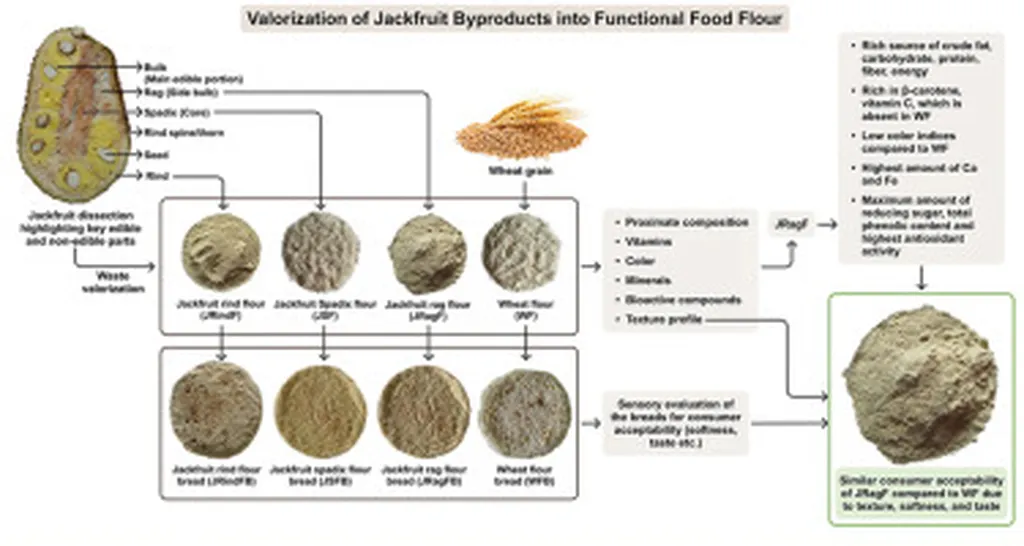
Jackfruit, known for its large size and numerous bulbs, typically sees only the yellow fleshy bulb consumed, while the rest is discarded as waste. However, this new research led by Jahidul Hassan from the Department of Horticulture at Gazipur Agricultural University in Bangladesh, in collaboration with Kyushu University in Japan, suggests that these byproducts—jackfruit rag, rind, and spadix—can be valorized into functional food ingredients. Among these, jackfruit rag flour (JRagF) stands out for its superior nutritional profile and sensory acceptability.
“Turning agricultural waste into valuable products is not just about reducing waste; it’s about creating new opportunities for farmers and food manufacturers,” says Hassan. The study found that JRagF contains higher levels of crude fat, carbohydrates, total phenolic content, β-carotene, vitamin C, calcium, and iron compared to other jackfruit byproducts. It also boasts significant protein, fiber, and antioxidant activity, making it a nutrient-dense alternative to traditional wheat flour.
The sensory evaluation further supports JRagF’s potential, with a score of 8.5 out of 10, closely matching wheat flour’s 8.9. This suggests that consumers could readily accept products made with JRagF, despite its different color profile. “The sensory acceptability of JRagF is a game-changer,” Hassan explains. “It means that food manufacturers can incorporate this flour into their products without compromising on taste or texture.”
The commercial implications for the agriculture sector are substantial. By valorizing jackfruit waste, farmers can generate additional revenue streams, while food manufacturers can diversify their product offerings with nutrient-rich, sustainable ingredients. This research could also inspire similar studies on other fruit and vegetable byproducts, paving the way for a more circular and sustainable food system.
Principal component and cluster analyses confirmed JRagF’s nutritional and sensory superiority over other jackfruit byproducts-derived flours. This study not only highlights the potential of jackfruit waste but also sets a precedent for future research in agricultural valorization. As the world grapples with food security and environmental challenges, innovative solutions like these offer hope for a more sustainable future.
The research, led by Jahidul Hassan and published in the *Journal of Agriculture and Food Research*, underscores the importance of exploring underutilized agricultural resources. By doing so, we can unlock new opportunities for farmers, food manufacturers, and consumers alike, contributing to a more resilient and sustainable food system.