
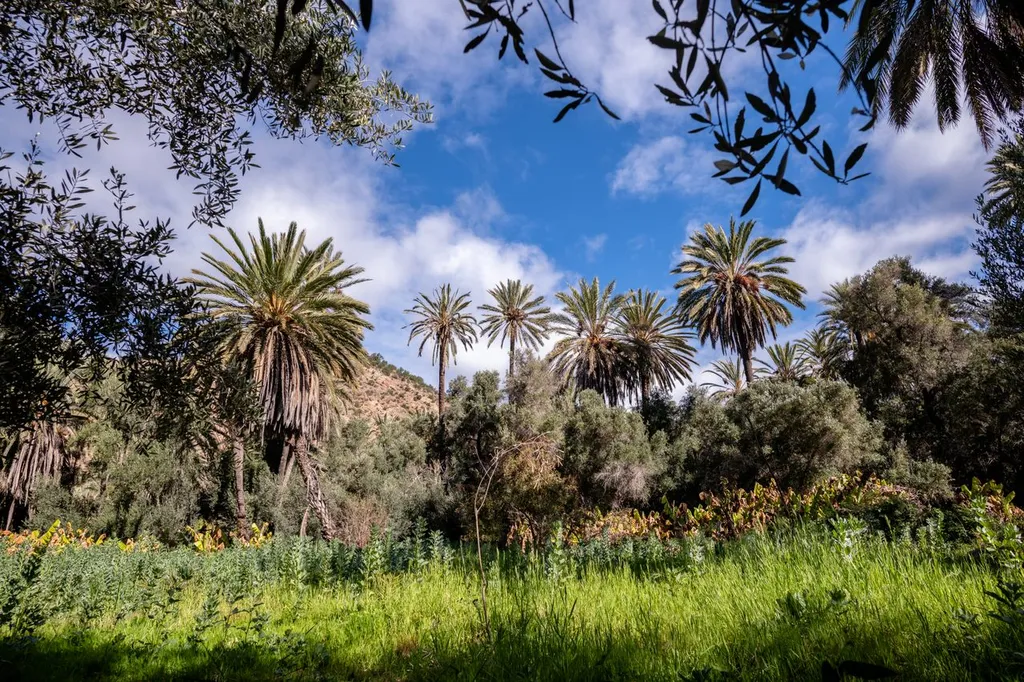
In the sun-scorched landscapes of Morocco’s Argan Biosphere Reserve, a quiet revolution is taking root. Researchers have been delving into the carbon-sequestering potential of argan orchards, and their findings could reshape the way we view agriculture in arid regions. The study, published in *Ecological Processes*, offers a nuanced look at how these extensive argan orchards, aged 2 to 10 years, are storing carbon across various ecosystem components.
The research, led by Assma Oumasst of the Regional Center of Agricultural Research of Agadir, National Institute of Agricultural Research, quantifies carbon stocks in above-ground argan biomass, leaf litter, herbaceous vegetation, and soil. The results are promising, with soil organic carbon (SOC) emerging as the dominant carbon reservoir. “The total soil organic carbon stock varied significantly, from 10.12 to 80.5 t C ha-1 at a depth of 0–30 cm and from 8.49 to 75.94 t C ha-1 at a depth of 30–60 cm,” Oumasst explains. This underscores the critical role of soil in carbon sequestration, even in arid environments.
The study also highlights the potential of arganiculture in Morocco’s Nationally Determined Contributions under the Paris Agreement. By integrating carbon markets, farmers could potentially generate additional revenue streams, making argan cultivation even more attractive. “These findings position arganiculture as a viable component of Morocco’s Nationally Determined Contributions, aiding in carbon market integration,” Oumasst notes.
The commercial implications are substantial. As the world grapples with climate change, the demand for sustainable agricultural practices is on the rise. Argan orchards, with their proven carbon-sequestering capabilities, could become a cornerstone of sustainable farming in arid regions. This could open up new opportunities for farmers, agribusinesses, and investors alike.
The research also sheds light on the complex interactions among orchard components using structural equation modeling. This approach provides a holistic view of the ecosystem, enabling better management practices. “Structural equation modeling was applied to elucidate the complex interactions among the orchard components,” Oumasst says. This could lead to more efficient and sustainable farming practices, benefiting both the environment and the agriculture sector.
Looking ahead, this research could shape future developments in arid agriculture. By understanding the carbon dynamics in argan orchards, researchers and farmers can develop strategies to enhance carbon sequestration and mitigate climate change. This could pave the way for similar studies in other arid regions, potentially revolutionizing agriculture in drylands worldwide.
In conclusion, the study published in *Ecological Processes* offers a comprehensive analysis of carbon sequestration dynamics in arganiculture ecosystems. With soil organic carbon identified as the dominant carbon reservoir, the findings highlight the potential of argan orchards in sustainable agriculture and carbon market integration. As the world seeks sustainable solutions to climate change, arganiculture could emerge as a key player in the fight against global warming.