
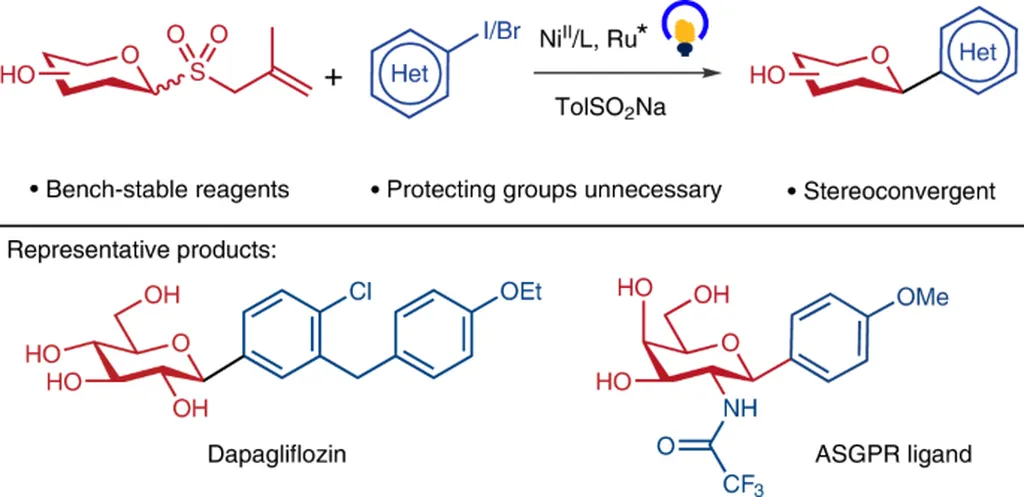
In a groundbreaking development that could reshape the landscape of drug discovery and materials science, researchers have unveiled a novel method for synthesizing aryl C-glycosides, a class of compounds with significant potential in various industries, including agriculture. The study, published in *Nature Communications*, introduces a highly efficient radical cross-coupling approach that addresses longstanding challenges in the synthesis of these privileged scaffolds.
Traditionally, the synthesis of aryl C-glycosides has relied on radical cross-coupling methods that require glycosyl donors, which are often unstable and necessitate prefunctionalization at the anomeric position. This prefunctionalization step not only complicates the process but also limits the scalability and commercial viability of the resulting compounds. The new method, developed by a team led by Xiang-Yu Ye at the School of Chemistry, Chemical Engineering, and Biotechnology at Nanyang Technological University, overcomes these hurdles by activating the native hydroxyl group on saccharides in situ using a phosphorus reagent.
“This approach allows us to bypass the need for prefunctionalization, making the process more efficient and scalable,” said Ye. “The glycosyl donors we use are bench-stable and readily available, which addresses many of the issues associated with previous methods.”
The method employs a combination of zinc and iodine to initiate a key β-scission step, enabling the formation of C−C bonds with aryl iodides. This results in a broad range of aryl C-glycosides, which are valuable in drug discovery, biochemical research, and materials science. The potential applications in the agriculture sector are particularly noteworthy, as these compounds can be used to develop novel pesticides, herbicides, and other agrochemicals with enhanced efficacy and reduced environmental impact.
“The ability to synthesize these compounds more efficiently and cost-effectively opens up new possibilities for their use in agriculture,” said Ye. “This could lead to the development of more sustainable and effective agrochemicals, benefiting both farmers and the environment.”
The study also provides mechanistic insights through a combination of experimental data and density functional theory (DFT) calculations, offering strong support for the proposed reaction mechanism. This understanding could pave the way for further advancements in the field, as researchers explore new applications and optimize the synthesis process.
As the agricultural industry continues to seek innovative solutions to enhance productivity and sustainability, the development of efficient and scalable methods for synthesizing aryl C-glycosides represents a significant step forward. The research led by Xiang-Yu Ye at Nanyang Technological University not only addresses critical challenges in the synthesis of these compounds but also opens up new avenues for their application in agriculture and beyond. With its potential to revolutionize the way we develop and use agrochemicals, this breakthrough is poised to shape the future of the agricultural industry.