
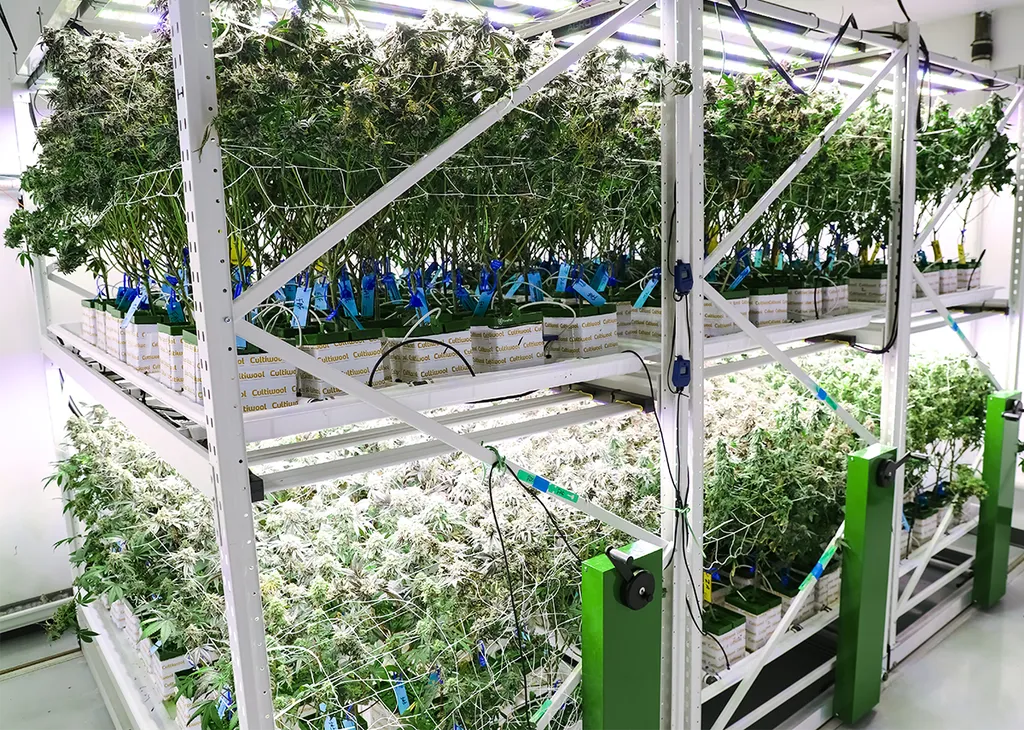
In the ever-evolving world of agriculture, vertical farming has emerged as a promising frontier, offering innovative solutions to age-old challenges. A recent study published in *Frontiers in Plant Science* sheds light on how LED-driven propagation strategies can revolutionize the production of hardy nursery stock, potentially reshaping the industry’s approach to woody plant propagation.
The research, led by Kambiz Baghalian from the Writtle School of Agriculture, Animal and Environmental Sciences at Anglia Ruskin University, focused on three evergreen woody ornamentals: Elaeagnus × ebbingei, Pittosporum tenuifolium, and Euonymus japonicus. These species were chosen to represent varying degrees of rooting difficulty, providing a comprehensive overview of the potential impacts of LED lighting on propagation success.
Traditionally, the propagation of semi-hardwood or hardwood cuttings has been fraught with inconsistencies, largely due to species-specific constraints and environmental variability. However, Baghalian’s study suggests that tailored LED strategies could enhance rooting uniformity and efficiency, offering a more controlled and predictable approach to nursery stock production.
The study compared the effects of ambient light with two distinct LED treatments, differing in red-to-blue ratio and intensity. The findings were intriguing. Euonymus japonicus, for instance, achieved the highest biomass under a 7:1 red-to-blue ratio, while Elaeagnus × ebbingei and Pittosporum tenuifolium performed best under ambient light. This species-specific response underscores the importance of customizing LED strategies to maximize propagation success.
“Our results demonstrate that species-specific responses shape propagation outcomes,” Baghalian noted. “Tailored LED strategies can enhance rooting uniformity and efficiency, which is a game-changer for the nursery stock industry.”
The study also revealed that chlorophyll content declined under LED treatments across all species but remained most stable in Euonymus japonicus. This finding suggests that rooting responses are more closely associated with carbon allocation processes than with pigment stability, a nuanced insight that could inform future propagation strategies.
From a commercial perspective, the implications are significant. Vertical farming systems equipped with optimized LED lighting could lead to more consistent and efficient propagation of hardy nursery stock, reducing waste and increasing profitability. As the agriculture sector continues to embrace technological advancements, such innovations could play a pivotal role in meeting the growing demand for woody ornamentals.
Looking ahead, this research opens up new avenues for exploration. As Baghalian and his team continue to delve into the intricacies of LED-driven propagation, the potential for further breakthroughs in vertical farming and controlled environment systems becomes increasingly apparent. The future of agriculture is bright, and with continued innovation, the industry is poised to overcome longstanding challenges and achieve new heights of success.