
In the quest to transform agricultural and industrial waste into valuable resources, a recent study published in *Earth Critical Zone* has shed light on the intricate dance of microorganisms and their role in nitrogen transformation during aerobic composting. The research, led by Jiatu Li from the Engineering Research Center of Agricultural Microbiology Technology at Heilongjiang University, explores how biochar and manganese dioxide (MnO2) can regulate nitrogen dynamics through quorum sensing and two-component systems, offering promising avenues for sustainable agriculture.
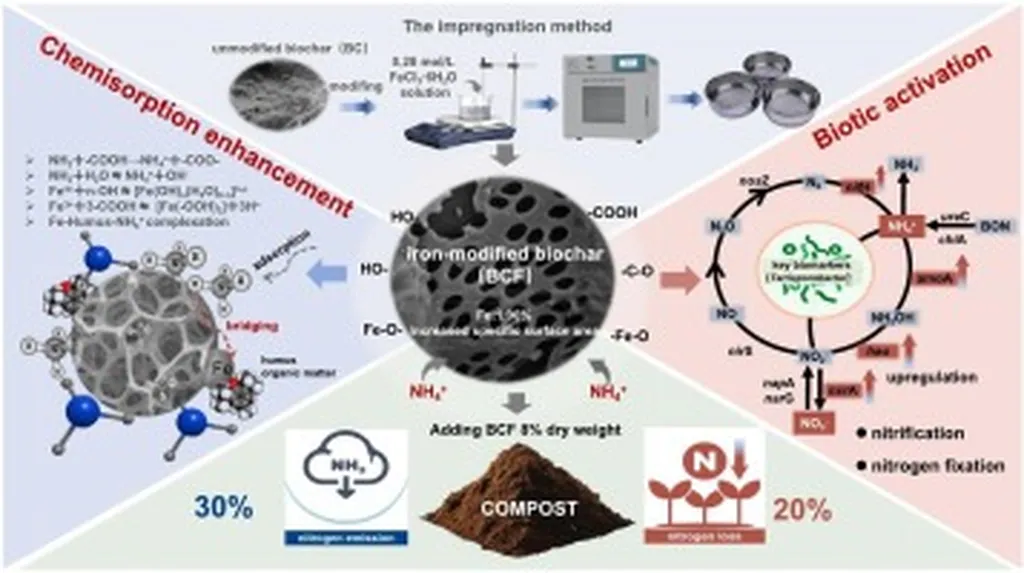
Aerobic composting is a cornerstone of waste management, turning organic waste into nutrient-rich compost. However, the efficiency of nitrogen transformation—a critical nutrient for plant growth—has been a persistent challenge. Li’s study investigated the effects of biochar and MnO2 on nitrogen transformation in a mixture of flax retting wastewater (FRW), straw, and chicken manure. The findings are compelling: the addition of FRW increased total nitrogen content by 39.2%, while biochar and MnO2 further enhanced nitrogen transformation, reducing losses of ammonium (NH4+-N) and nitrate (NO3−-N) by 32.26% and 2.10%, respectively.
The study delves into the microbiological mechanisms driving these transformations. Biochar was found to improve temperature perception in core microbial groups, promoting genera like Ornithinicoccus and Thermobifida. These microbes utilize specific gene pathways, such as luxQ-luxN, rpfC-rpfG, and qseC-qseF, to accelerate NH4+-N accumulation. “Biochar essentially helps these microbes thrive in higher temperatures, enabling them to optimize nitrogen retention,” Li explains.
On the other hand, MnO2 enhanced microbial adaptation to pH changes, increasing pH tolerance in bacteria like Enterococcus and Bacillus. This stimulated genes involved in nitrification and anaerobic ammonium oxidation, stabilizing NO3−-N retention. “MnO2 acts as a pH buffer, creating a more stable environment for these microbes to perform their nitrogen-transforming functions,” Li adds.
The implications for the agriculture sector are significant. Efficient nitrogen management is crucial for sustainable farming practices, as nitrogen is a key component of fertilizers. By optimizing aerobic composting processes with biochar and MnO2, farmers can reduce nitrogen losses, improve soil fertility, and minimize environmental pollution. “This research provides a roadmap for enhancing compost quality and nutrient retention, which can lead to more sustainable and productive agricultural systems,” Li notes.
Looking ahead, this study opens doors for further research into microbial-driven nutrient transformation pathways. Understanding and harnessing these mechanisms could revolutionize waste management and nutrient recycling in agriculture. As the world grapples with food security and environmental sustainability, such innovations are not just beneficial—they are essential.
The research, led by Jiatu Li from the Engineering Research Center of Agricultural Microbiology Technology at Heilongjiang University, was published in *Earth Critical Zone*, offering a glimpse into the future of sustainable agriculture and waste management.