
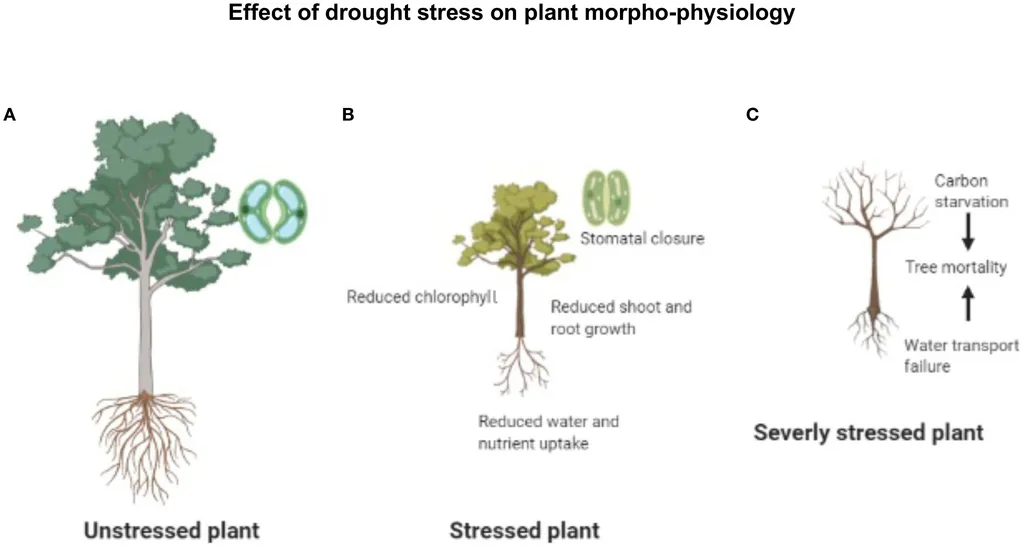
In the heart of Iran’s arid regions, a resilient medicinal plant is teaching scientists valuable lessons about survival and productivity under drought conditions. Zataria multiflora Boiss., a member of the Lamiaceae family, is not just weathering the storm; it’s thriving and producing more of the valuable compounds that make it so sought after in industries ranging from pharmaceuticals to food and beverage. A recent study published in *Industrial Crops and Products* sheds light on how controlled drought stress can enhance the plant’s secondary metabolites, offering promising insights for the agriculture sector.
The research, led by Zabihollah Mohammad Alipour from the Department of Plant Bioproducts at the Agricultural Biotechnology Research Institute in Tehran, explored how different irrigation levels—100%, 75%, and 50%—affect the growth, physiology, and phytochemical production of Z. multiflora. The findings reveal a fascinating trade-off: as drought stress increases, the plant’s shoot growth is inhibited, but its root systems become more robust, and its production of valuable secondary metabolites, particularly carvacrol and thymol, skyrockets.
“Under 50% field capacity, we observed a 36.33% reduction in growth rate, but this was offset by a significant enhancement in antioxidant defenses and a substantial increase in carvacrol and thymol levels,” Alipour explained. These compounds are not just valuable for their medicinal properties; they are also key ingredients in various industrial applications, from food preservation to fragrance production.
The study’s results suggest that controlled irrigation could be a game-changer for farmers cultivating Z. multiflora and similar medicinal plants. By strategically managing water levels, producers could potentially boost the yield of high-value secondary metabolites while also enhancing the plant’s resilience to drought conditions. This could be particularly beneficial in arid agroecosystems, where water scarcity is a significant challenge.
The research also delved into the genetic and biochemical mechanisms underlying these responses. Gene expression analysis revealed the upregulation of McWRKY57 and ABAR6, indicating the activation of abscisic acid-dependent and transcriptional stress pathways. This metabolic reprogramming under drought stress not only enhances the plant’s survival but also its productivity, making it a prime candidate for sustainable agriculture practices in water-scarce regions.
Principal component analysis further highlighted the treatment-specific responses. Plants under 100% irrigation prioritized shoot growth, while those under 50% field capacity exhibited a root-dominated architecture with increased secondary metabolites. The 75% group displayed a balanced adaptation, suggesting that there is an optimal level of water stress that maximizes both growth and phytochemical production.
The implications of this research extend beyond Z. multiflora. The findings could pave the way for similar studies on other medicinal and aromatic plants, potentially revolutionizing the way we approach crop cultivation in arid regions. By understanding and harnessing the plant’s natural responses to drought, farmers and agritech companies could develop more sustainable and profitable agricultural practices.
As the global demand for natural and organic products continues to rise, the ability to enhance the production of valuable secondary metabolites through controlled irrigation could offer a significant competitive advantage. This research not only highlights the potential for improving crop yields under drought conditions but also underscores the importance of integrating advanced biotechnological approaches into traditional agricultural practices.
In the words of Alipour, “This study opens up new avenues for optimizing the cultivation of medicinal plants in arid regions, ensuring both sustainability and profitability.” As we face increasing challenges from climate change and water scarcity, such innovative approaches will be crucial in shaping the future of agriculture.