
In the quest to enhance crop resilience and productivity, scientists have long turned to the genetic blueprints of plants for answers. A recent study published in *Industrial Crops and Products* has shed new light on the MADS-box gene family in poplar trees, offering promising insights for the agriculture sector. Led by Yufei Xia from the State Key Laboratory of Tree Genetics and Breeding at Beijing Forestry University, the research delves into the intricate world of MADS-box genes, which play pivotal roles in plant growth, hormone signaling, and secondary metabolism.
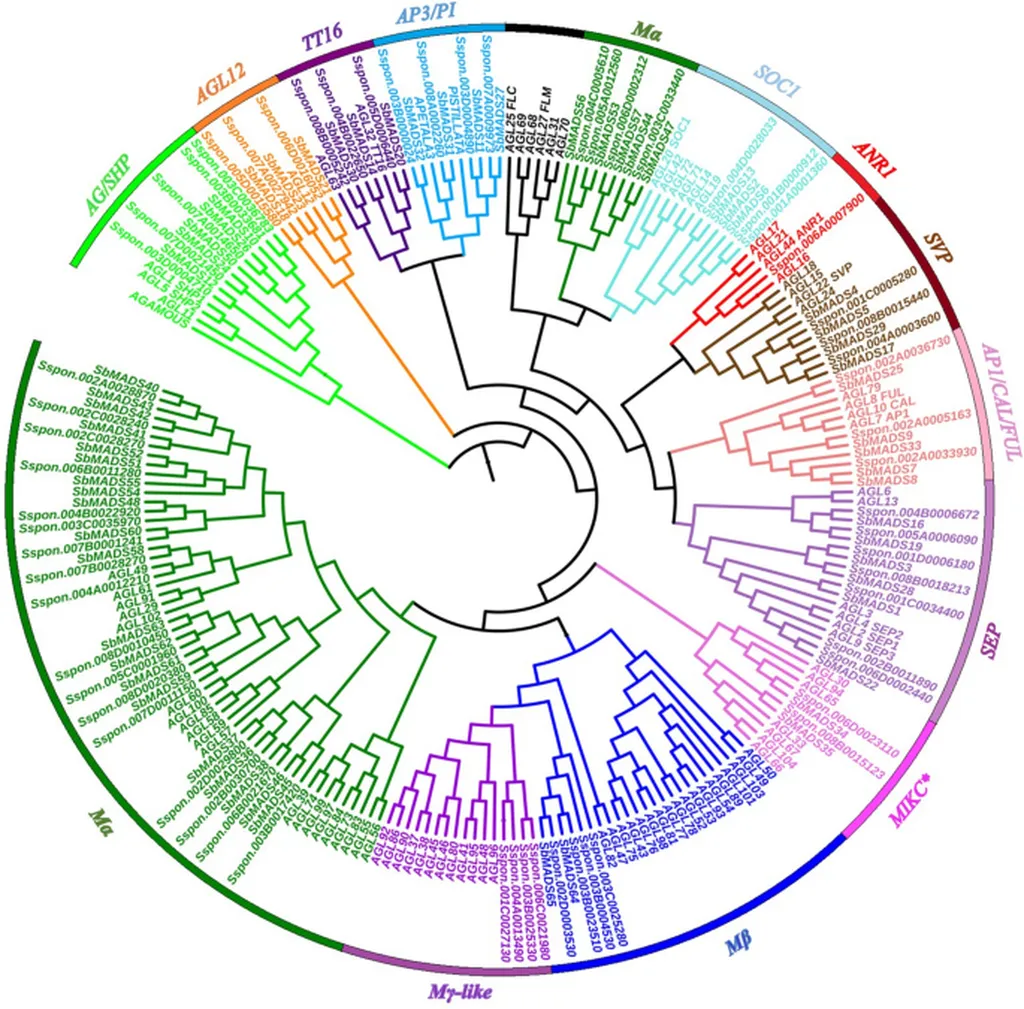
The study identified 150 MADS-box genes in the 84K poplar (Populus alba × P. glandulosa), meticulously analyzing their phylogeny, gene structure, conserved motifs, collinearity, and cis-acting elements. These genes were clustered into 17 groups, revealing that their evolution is influenced by domain and motif distributions and shaped by multiple segmental and tandem duplication events. This comprehensive characterization provides a foundational understanding of the MADS-box gene family in poplar, a woody plant of significant economic importance.
One of the most compelling findings revolves around the PagMADS23a gene. Differential gene expression analysis between tetraploid and diploid poplars revealed that PagMADS23a is significantly downregulated in the apical buds of tetraploid poplars. Transgenic analysis showed that overexpressing PagMADS23a increased stomatal density, promoting vegetative growth but reducing drought tolerance. Conversely, RNAi lines displayed opposite phenotypes, highlighting the gene’s crucial role in stomatal development and drought resistance.
“Our findings suggest that PagMADS23a is a key regulator of stomatal density, which has profound implications for plant growth and drought tolerance,” said Yufei Xia. “Understanding the genetic mechanisms behind these processes can help us develop more resilient crops that can thrive in challenging environments.”
The implications for the agriculture sector are substantial. By manipulating the expression of genes like PagMADS23a, scientists can potentially enhance crop resilience to drought, a critical factor in the face of climate change. This research could pave the way for the development of genetically modified crops that require less water, thereby conserving resources and improving agricultural sustainability.
Moreover, the study’s insights into the MADS-box gene family could have broader applications in plant breeding and biotechnology. By understanding the genetic underpinnings of plant growth and development, researchers can tailor crops to meet specific agricultural needs, whether it’s improving yield, enhancing disease resistance, or optimizing nutrient uptake.
As the global population continues to grow, the demand for food and other agricultural products is expected to rise. Innovations in plant genetics, such as those highlighted in this study, are essential for meeting these demands sustainably. The research published in *Industrial Crops and Products* not only advances our understanding of plant biology but also opens new avenues for agricultural innovation, offering hope for a more resilient and productive future.