
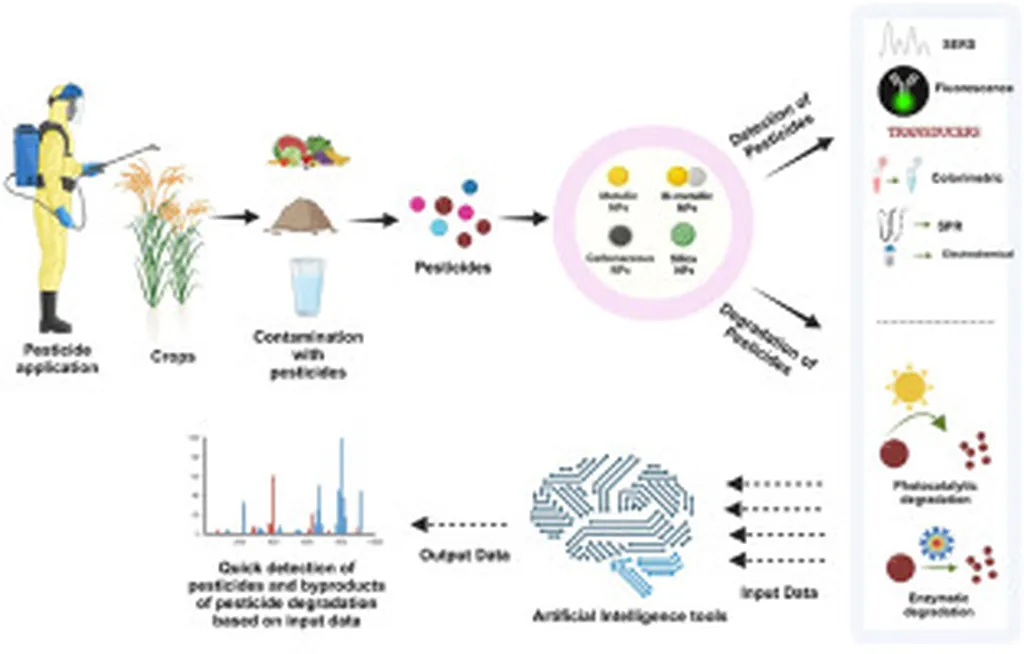
In the ever-evolving landscape of agricultural technology, a recent study published in *Scientific Reports* has introduced a novel approach to tackling a persistent challenge: the biodegradation of pyrethroids, a class of synthetic insecticides widely used in agriculture but notorious for their environmental persistence. The research, led by Saurabh Gangola from the School of Agriculture at Graphic Era Hill University, presents a decision-making system that optimizes microbial strain selection for pyrethroid biodegradation, potentially revolutionizing how we manage pesticide contamination in agricultural environments.
Pyrethroids are a cornerstone of modern pest control, valued for their effectiveness and relatively low toxicity to mammals. However, their environmental persistence poses significant risks to non-target species and ecosystems. Traditional methods of remediation often fall short, either due to inefficiency or high costs. Enter Gangola’s research, which leverages the Technique for Order Preference by Similarity to Ideal Solution (TOPSIS), a multi-criteria decision-making tool, to identify the most effective microbial strains for breaking down these persistent chemicals.
The TOPSIS-based system evaluates multiple factors, including biodegradation efficiency, adaptability to different environmental conditions, and the economic viability of large-scale deployment. “This approach allows us to systematically compare and rank microbial strains based on their performance and practicality,” explains Gangola. “By doing so, we can identify the most promising candidates for field applications, ultimately enhancing the efficiency and sustainability of pyrethroid remediation.”
The commercial implications for the agriculture sector are substantial. Farmers and agribusinesses stand to benefit from more effective and cost-efficient methods of managing pesticide contamination, reducing the environmental footprint of agricultural practices. “The ability to selectively deploy the most effective microbial strains could lead to significant cost savings and improved environmental outcomes,” says Gangola. “This could be a game-changer for sustainable agriculture.”
Beyond immediate applications, this research opens the door to broader innovations in biotechnology and environmental science. The TOPSIS-based decision-making framework could be adapted to address other environmental challenges, such as the biodegradation of other persistent pollutants or the remediation of contaminated soils and water bodies. “The versatility of this approach is one of its most exciting aspects,” notes Gangola. “It provides a robust tool for decision-making that can be applied across various fields, from agriculture to environmental engineering.”
As the agriculture sector continues to grapple with the dual demands of productivity and sustainability, innovations like Gangola’s TOPSIS-based system offer a beacon of hope. By optimizing microbial strain selection for pyrethroid biodegradation, this research not only addresses a critical environmental issue but also paves the way for more sustainable and efficient agricultural practices. The study, published in *Scientific Reports* and led by Saurabh Gangola from the School of Agriculture at Graphic Era Hill University, underscores the transformative potential of integrating advanced decision-making tools with biotechnological solutions. As the field continues to evolve, such interdisciplinary approaches will be key to shaping a more sustainable future for agriculture and the environment.