
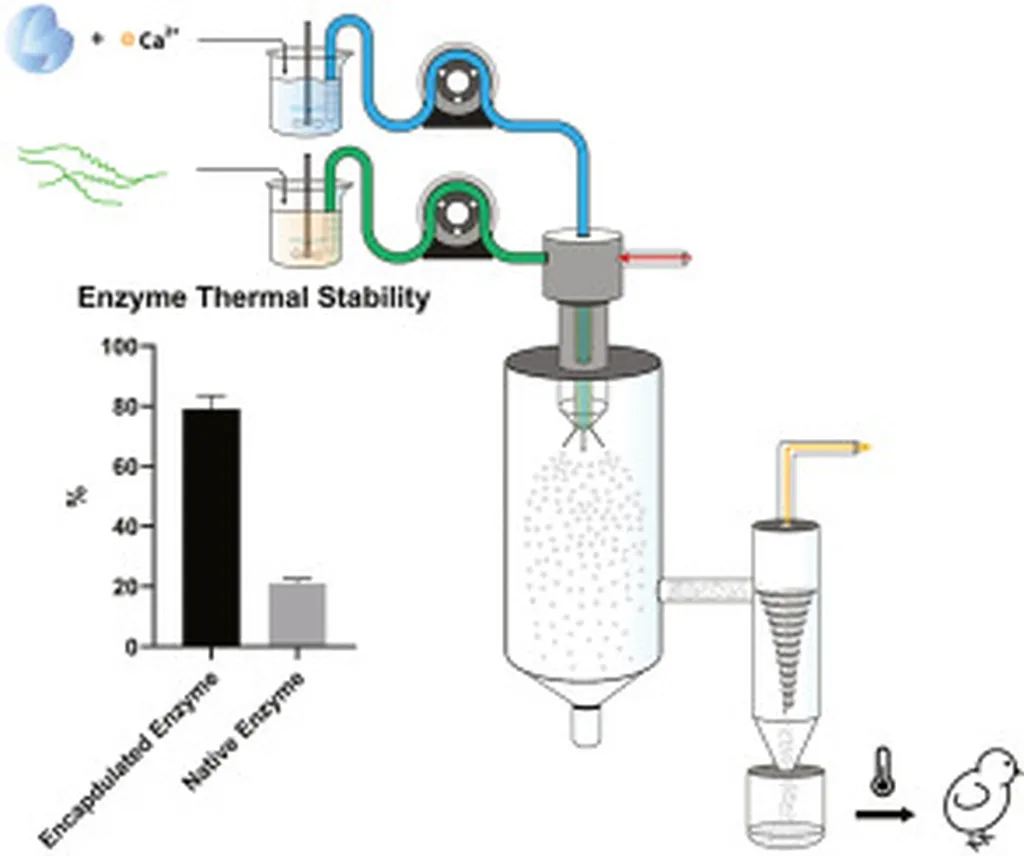
In the quest to enhance feed efficiency and sustainability in agriculture, researchers have turned to microbial enzymes, which can significantly improve feed digestibility. However, high production costs and low stability have posed substantial challenges. A recent study published in *Scientific Reports* offers a promising solution by optimizing the production of multiple enzymes from a single bacterial strain and encapsulating them for enhanced stability.
The research, led by Hamza Rafeeq from the Department of Biochemistry at the University of Agriculture Faisalabad, focuses on Bacillus subtilis, a well-known bacterium with a rich history in biotechnology. The team optimized the production of four key enzymes—protease, lipase, cellulase, and amylase—using response surface methodology, a statistical technique that helps identify the best conditions for complex processes. “By fine-tuning the production conditions, we were able to maximize enzyme yields, making the process more cost-effective,” Rafeeq explained.
But optimization was just the first step. The researchers then encapsulated these enzymes in alginate beads, a simple and food-grade carrier. This encapsulation widened the enzymes’ active pH and temperature ranges, making them more versatile for different feed formulations. Perhaps most importantly, it significantly improved their storage stability. After 30 days at 4°C, encapsulated enzymes retained 60–74% of their activity, compared to just 34–42% for free enzymes.
The implications for the agriculture sector are substantial. Enzymes are already used in animal feed to improve digestibility and nutrient absorption, but their high cost and instability have limited their widespread adoption. This research could change that. “The simultaneous optimization of four enzymes from a single strain, coupled with their stabilization using a simple carrier, represents a significant advancement,” Rafeeq noted. This could lead to more affordable and effective feed additives, ultimately improving animal health and productivity while reducing feed waste.
The study’s findings also open up new avenues for future research. While the results are promising in vitro, in vivo trials are needed to confirm their practical application in real-world settings. If successful, this approach could be extended to other enzymes and microbial strains, further expanding the toolkit for sustainable agriculture.
In the broader context, this research highlights the potential of biotechnology to address some of the most pressing challenges in agriculture. As the global demand for food continues to grow, innovations like these will be crucial in ensuring efficient and sustainable food production. The study not only advances our understanding of enzyme production and stabilization but also paves the way for more robust and cost-effective feed additives, benefiting farmers and consumers alike.