
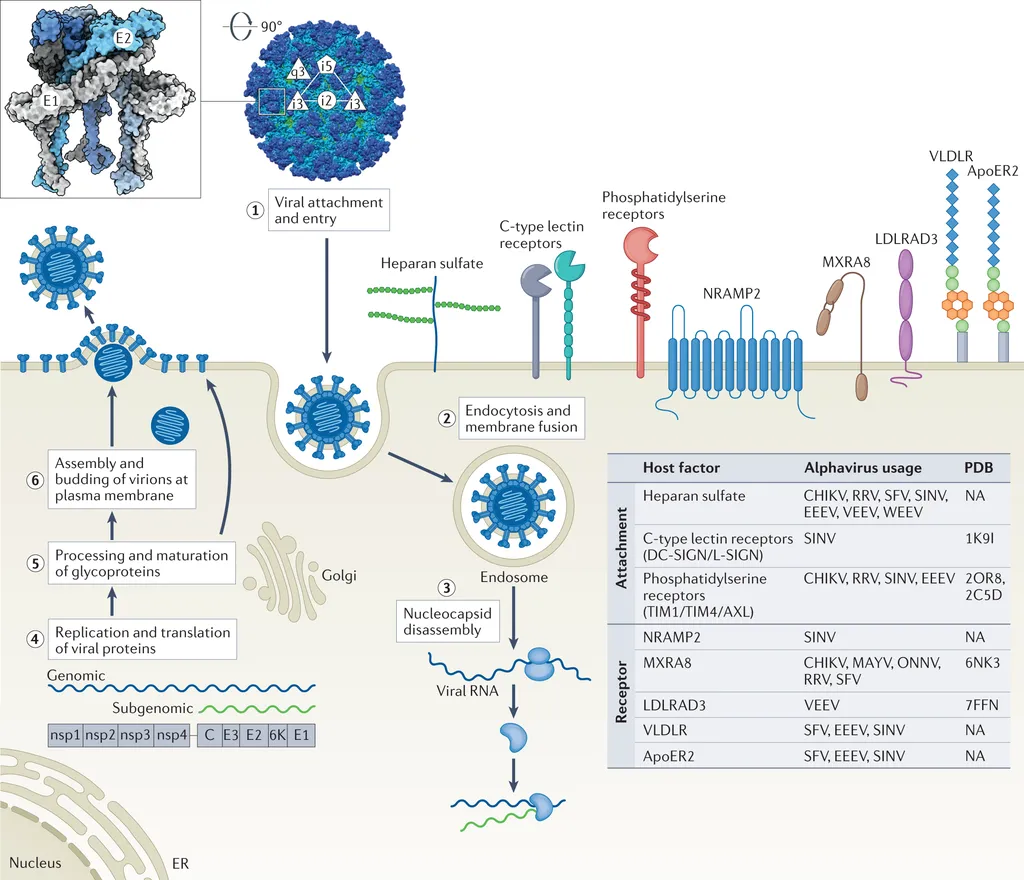
In a significant breakthrough published in *Nature Communications*, researchers have unraveled the molecular mechanisms behind how the Semliki Forest virus (SFV) enters cells via the apolipoprotein E receptor 2 (ApoER2). This discovery, led by Bingchen Du from the State Key Laboratory for Animal Disease Control and Prevention at the Harbin Veterinary Research Institute, Chinese Academy of Agricultural Sciences, could pave the way for innovative strategies to combat SFV infections in livestock, a critical concern for the agriculture sector.
The study reveals that among the seven LA domains of ApoER2 isoform 1, only the LA5 domain specifically binds to the SFV E1-DIII, facilitating cell attachment and entry. This finding is distinct from the mechanism involving the very low-density lipoprotein receptor (VLDLR), which interacts with SFV through multiple LA domains. By determining the cryogenic electron microscopy (cryo-EM) structures of SFV complexed with ApoER2 LA5 and full-length ApoER2, the researchers identified a limited interface (353 Ų) crucial for this interaction.
“Our findings demonstrate a unique LA5-dependent receptor engagement mechanism for SFV entry via ApoER2,” said lead author Bingchen Du. “This discovery not only enhances our understanding of viral entry mechanisms but also opens up new avenues for developing targeted therapies and preventive measures.”
The implications for the agriculture sector are substantial. SFV infections can have devastating effects on livestock, leading to significant economic losses. By understanding the molecular basis of SFV entry, researchers can develop soluble LA5 decoy receptors that neutralize SFV infection. In fact, the study showed that such decoy receptors could protect mice from lethal SFV challenges, suggesting a promising approach for veterinary applications.
“This research is a game-changer,” said a senior scientist at a leading agricultural research institute. “By targeting the specific interaction between SFV and ApoER2, we can develop more effective and targeted treatments, reducing the impact of SFV on livestock and, consequently, on the agricultural economy.”
The study also highlights the potential for broader applications in virology and immunology. The detailed structural and functional insights into ApoER2-mediated viral entry could inform the development of new antiviral strategies for other viruses that exploit similar entry mechanisms.
As the agriculture sector continues to grapple with the challenges posed by viral infections, this research offers a beacon of hope. By leveraging the molecular intricacies of viral entry, scientists can develop innovative solutions that protect livestock and ensure food security. The findings published in *Nature Communications* by Bingchen Du and colleagues represent a significant step forward in this endeavor, underscoring the importance of fundamental research in driving agricultural advancements.