
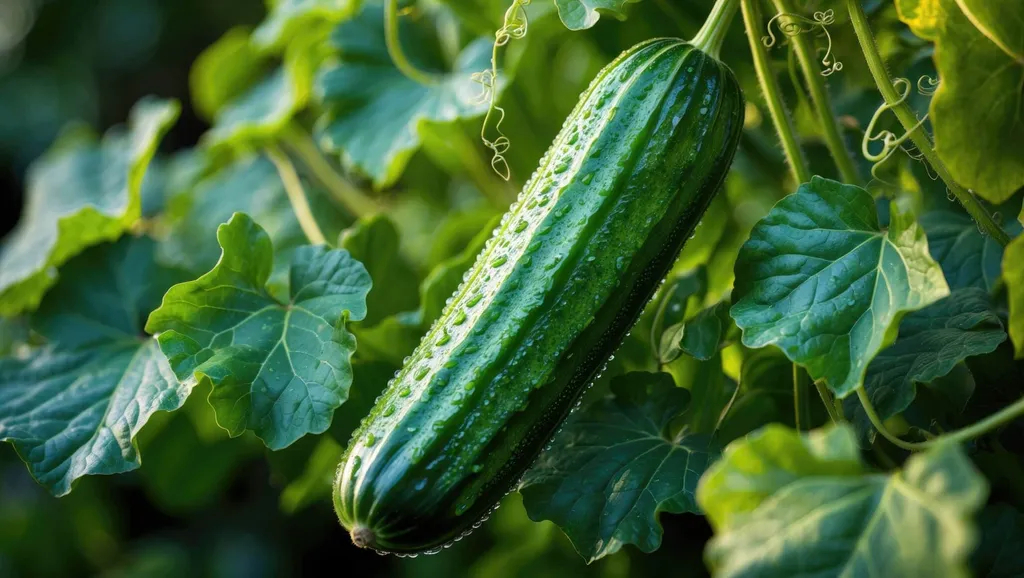
In the world of cucumber cultivation, timing is everything. A recent study published in *BMC Plant Biology* has uncovered significant genetic insights that could revolutionize the way we breed and cultivate cucumbers, offering promising advancements for the agriculture sector. The research, led by N. Pradeepkumara from the Division of Vegetable Science at ICAR-Indian Agricultural Research Institute, delves into the molecular mapping of flowering traits in cucumbers, identifying key genetic markers that could enhance yield and efficiency in cucumber production.
Cucumbers are a staple in both domestic and international markets, primarily grown as a summer crop in tropical and subtropical regions. The study focused on desirable traits such as early pistillate flowering and lower nodes for female flower initiation, which are crucial for breeding high-yielding varieties and hybrids. “Understanding these traits at a molecular level can significantly impact the agricultural industry by enabling the development of cucumber varieties that mature faster and produce higher yields,” Pradeepkumara explained.
The research team developed a mapping population using two contrasting cucumber lines, DC-83 (early flowering) and DC-48 (late flowering), selected for their differences in flowering time and shelf-life traits. By analyzing 1,200 SSR primers and identifying 106 polymorphic primers, the team genotyped 125 individuals from the F₂ mapping population. This extensive genetic screening led to the identification of five quantitative trait loci (QTLs) associated with days to first female flower (DFFF) and node to first female flower (NFFF). These QTLs were mapped to chromosomes 2, 3, and 7, with the most significant QTL, qDFFF3.3.1, explaining 35.14% of the phenotypic variance.
The implications of this research are substantial for the agriculture sector. “The identification of these QTLs provides a robust foundation for marker-assisted selection (MAS) and genomic research, which can accelerate the development of high-yielding cucumber varieties,” Pradeepkumara noted. This breakthrough could lead to more efficient breeding programs, reducing the time and resources required to develop new cucumber cultivars with desirable traits.
Moreover, the study’s findings offer a strong scientific basis for diversity analysis, DNA fingerprinting, and genetic mapping for yield-related traits. This could facilitate the creation of cucumber varieties that are not only high-yielding but also better adapted to various environmental conditions. The commercial impact of these advancements is profound, as they can enhance the profitability and sustainability of cucumber farming worldwide.
As the agriculture sector continues to evolve, the integration of molecular markers and QTL mapping into breeding programs represents a significant step forward. This research, published in *BMC Plant Biology* and led by Pradeepkumara, underscores the potential of genetic insights to drive innovation in crop improvement. By leveraging these findings, the agriculture industry can look forward to a future where cucumber cultivation is more efficient, productive, and resilient.