
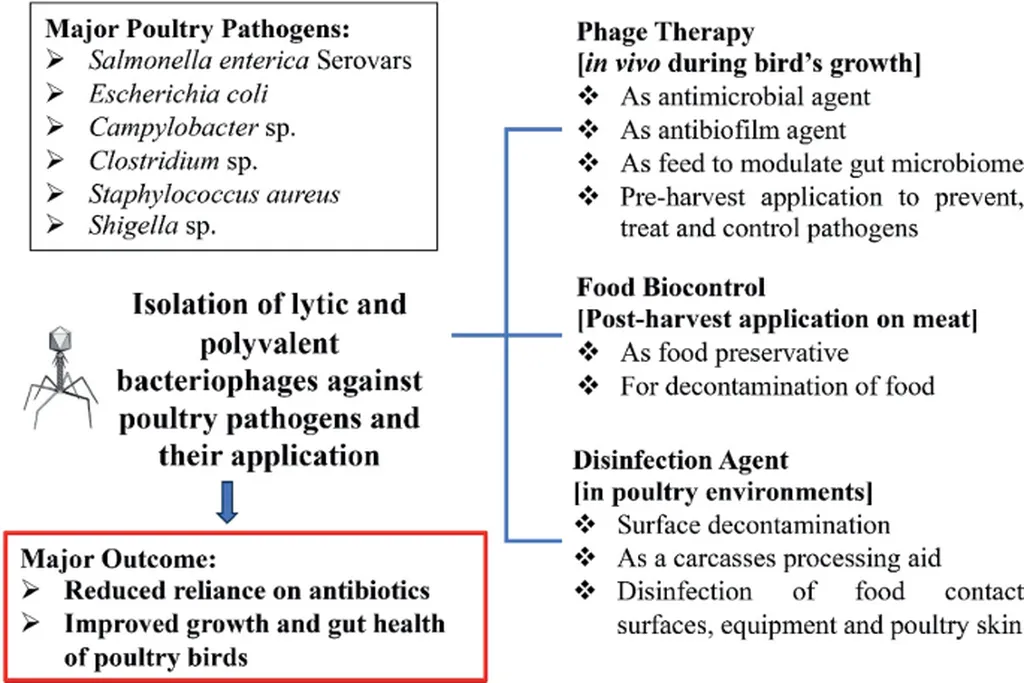
In the ongoing battle against antibiotic resistance in poultry, a groundbreaking study published in the *Journal of Animal Science and Biotechnology* offers a promising alternative strategy. Researchers led by Youbin Choi from the Department of Agricultural Biotechnology and Research Institute of Agriculture and Life Science at Seoul National University have demonstrated that a combination of bacteriophages and probiotics can effectively combat multidrug-resistant Salmonella infections in chicks while promoting intestinal health.
The study, which evaluated a cocktail of lytic Salmonella-infecting bacteriophages (SLAM_phiST45 and SLAM_phiST56) and a probiotic bacterium Limosilactobacillus reuteri (SLAM_LAR11), revealed significant improvements in infection outcomes. Co-administration of the phage-probiotic combination markedly reduced Salmonella colonization in the gut and systemic organs, comparable to the effect of phage-only treatment. However, the combined therapy also significantly improved body-weight gain and alleviated infection-associated splenomegaly and hepatomegaly.
“Our findings suggest that phage-probiotic co-administration not only enhances the clearance of multidrug-resistant Salmonella more effectively than phage treatment alone but also promotes intestinal health,” said lead author Youbin Choi. This dual benefit is crucial for the agriculture sector, where maintaining animal health and productivity is paramount.
The study also highlighted improvements in intestinal barrier function, with increased villus height-to-crypt depth ratio in the ileum and elevated expression of tight-junction genes in the colon. Additionally, the combination therapy led to a more balanced gut microbiota, with significant increases in beneficial bacteria such as Lactobacillus and Blautia, and trends toward decreases in pathogenic bacteria like Escherichia–Shigella and Clostridium.
The implications for the agriculture sector are substantial. As antibiotic resistance continues to pose a significant threat to poultry production, the development of effective alternatives is critical. The phage-probiotic combination offers a viable solution that not only combats infection but also promotes overall intestinal health, potentially leading to improved animal welfare and productivity.
“This research opens up new avenues for the development of antibiotic alternatives in poultry production,” Choi added. “By leveraging the synergistic effects of bacteriophages and probiotics, we can create more sustainable and effective strategies for managing infectious diseases.”
The study’s findings could shape future developments in the field, encouraging further research into the use of phage-probiotic combinations for other livestock species and potentially even humans. As the agriculture sector continues to seek innovative solutions to the challenges posed by antibiotic resistance, this research offers a promising path forward.
With the growing emphasis on sustainable and responsible agriculture, the phage-probiotic combination presents a compelling alternative that aligns with these principles. By reducing reliance on conventional antibiotics, this approach can help mitigate the development of antibiotic resistance, ensuring the long-term health and productivity of poultry flocks.
As the agriculture sector continues to evolve, the integration of such innovative strategies will be crucial in meeting the demands of a growing global population while prioritizing animal welfare and environmental sustainability. The research published in the *Journal of Animal Science and Biotechnology* marks a significant step in this direction, offering a glimpse into the future of poultry production and disease management.