
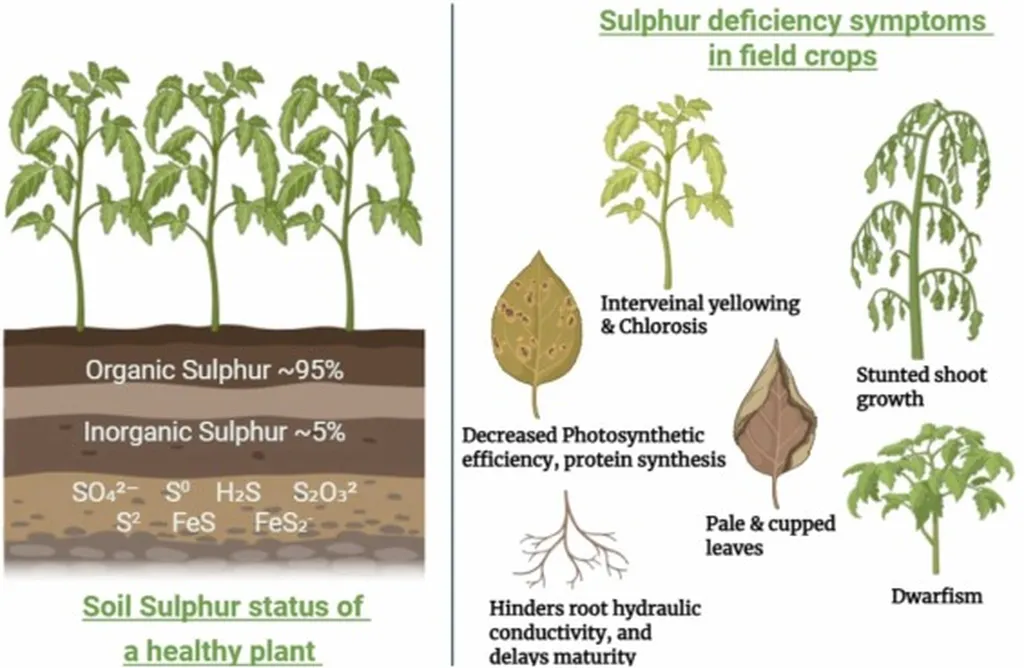
In the heart of Gujarat, India, a groundbreaking study is reshaping the way we think about sulfur use in agriculture. Researchers at Anand Agricultural University have discovered that sulfur nanoparticles (SNPs) could be the key to enhancing productivity and soil fertility in groundnut-mustard cropping systems. This isn’t just a local success story; it’s a potential game-changer for the global agriculture sector.
The study, led by Suwa Lal Yadav from the Department of Soil Science and Agricultural Chemistry, explored the impact of sulfur application, particularly SNPs, on yield, nutrient content, and soil sulfur dynamics. Over two years, the team applied various treatments of SNPs and elemental sulfur via fertigation, meticulously analyzing their effects on the groundnut-mustard system.
The results were striking. The highest chlorophyll content, seed, haulm, and stover yield, along with increased sulfur, iron, zinc, manganese, and copper content in plant parts, were observed under the recommended dose of fertilizer (RDF) combined with SNPs at 3.0 mg S/kg soil. This was applied in a split dose, with half at sowing and half a month later.
“The optimized application of SNPs significantly improved yield, nutrient uptake, and sulfur use efficiency,” Yadav explained. “This offers a sustainable alternative to conventional sulfur fertilizers, supporting long-term soil health and productivity.”
The study, published in ‘Scientific Reports’, also found that sulfur fractions and Diethylene Triamine Penta Acetic acid extractable micronutrients were highest at RDF combined with SNPs at 4.0 mg S/kg soil, split similarly. The lowest values were recorded under the control treatment, highlighting the stark contrast in outcomes.
So, what does this mean for the agriculture sector? The potential is immense. By improving sulfur use efficiency, farmers can enhance crop yields while reducing input costs. This is particularly crucial in the context of food security, as the global population continues to grow, and arable land becomes increasingly scarce.
Moreover, the use of SNPs could help mitigate environmental concerns associated with conventional sulfur fertilizers. By improving nutrient uptake, SNPs reduce the risk of nutrient runoff, which can lead to water pollution and eutrophication.
Looking ahead, this research could pave the way for further exploration into the use of nanoparticles in agriculture. As Yadav noted, “This approach supports sustainable agricultural practices and efficient nutrient management, ensuring long-term soil health and productivity.”
In the quest for sustainable and productive agriculture, this study offers a promising avenue. It’s a testament to the power of innovative research and its potential to transform the way we grow our food. As we face the challenges of a changing climate and a growing population, such advancements are not just welcome; they’re essential.