
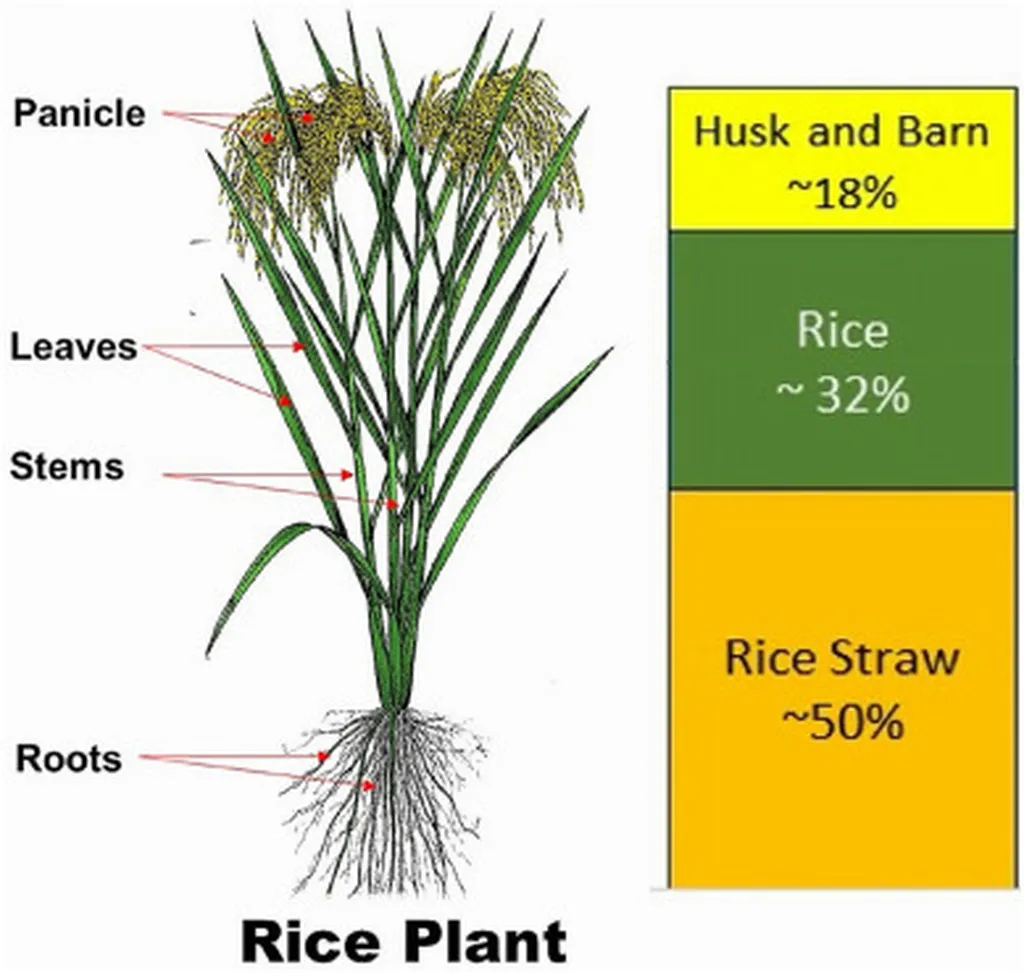
In the quest to harness the full potential of rice straw as a source of lignocellulosic biomass, a team of researchers led by Mahta Mohamadiaza from the Department of Cell and Molecular Biology at Shahid Beheshti University in Tehran, Iran, has made significant strides. Their study, published in the journal ‘Plant Direct’, delves into the genetic variation of rice straw characteristics and its influence on biomass production, offering promising insights for the agriculture and biofuel sectors.
The research team employed a genome-wide association study (GWAS) approach, utilizing 34,232 single-nucleotide polymorphic sites with a minor allelic frequency (MAF) greater than 0.05. By evaluating 32 morphological traits in 149 rice accessions at the heading stage, they identified 26 significant traits that could influence biomass production. “This comprehensive analysis allowed us to pinpoint specific genetic loci that control stem morphological traits, which are crucial for enhancing biomass yield,” Mohamadiaza explained.
The GWAS identified 173 significant SNPs located within 64 quantitative trait loci (QTLs) with putative functions in biomass production. Among the identified candidate genes, 21 were selected for further investigation, including WAK 53a and several DUF (domain of unknown function) genes. These genes were categorized into five groups: cytoskeletal and transport of cell wall components, growth and development, cell wall biosynthesis, wall-modifying genes, and regulatory genes. The three major transcription factor (TF) groups identified were WRKY, ERF, and MYB.
Haplotype analysis revealed seven haplogroups, with five being significant. Path analysis showed that panicle dry weight and internode 3 dry weight had the highest positive correlation with biomass, with correlation coefficients of 0.64 and 0.57, respectively. “Understanding these genetic variations and their impact on biomass production can pave the way for targeted breeding approaches and genome editing methodologies,” Mohamadiaza noted.
The implications of this research for the agriculture sector are substantial. By identifying key genetic loci and candidate genes involved in lignocellulosic biomass production, researchers can develop rice varieties with enhanced straw characteristics, leading to improved biomass yield. This, in turn, can boost the production of biofuels and other bioproducts derived from rice straw, contributing to a more sustainable and circular bioeconomy.
Moreover, the findings can inform breeding programs aimed at improving rice straw quality and quantity, ultimately benefiting farmers and agribusinesses. As the demand for renewable energy sources continues to grow, the ability to optimize biomass production from crops like rice becomes increasingly important.
This study represents the first comprehensive GWAS of various stem-related morphological traits in Oryza sativa, setting the stage for future research and practical applications. By leveraging the insights gained from this work, the agriculture sector can move closer to realizing the full potential of rice straw as a valuable source of lignocellulosic biomass.