
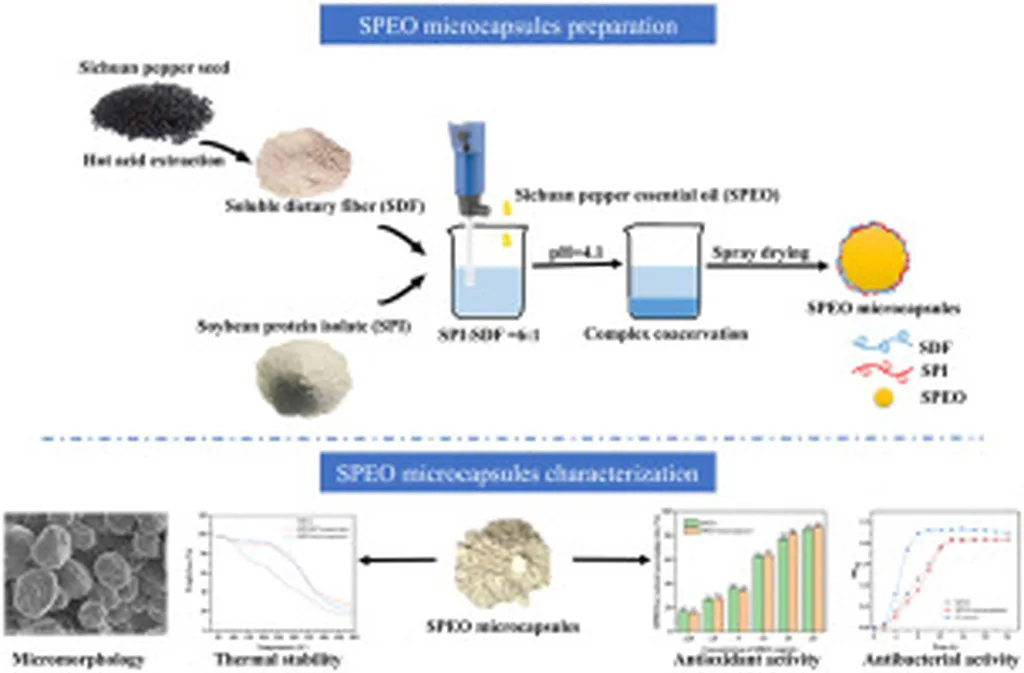
In the ever-evolving landscape of agricultural technology, a recent study published in *Food Chemistry: X* has shed light on a promising method to enhance the stability and functionality of Zanthoxylum bungeanum seed kernel oil, commonly known as Szechuan pepper oil. The research, led by Jiao Liu from the Engineering and Technology Center for Grain Processing of Shandong Province, explores the encapsulation of Zanthoxylum oil bodies (ZOBs) using a combination of soy protein isolate (SPI) and maltodextrin (MD) as wall materials.
The study delves into the intricate details of oil body composition, emulsion properties, and microencapsulation efficiency at varying pH levels. The findings reveal that ZOBs extracted at pH 11.0 exhibited superior emulsion stability and encapsulation efficiency compared to those extracted at pH 6.3. This discovery underscores the critical role of pH optimization in the isolation and microencapsulation process.
“Our research demonstrates that the pH level during extraction significantly impacts the stability and functionality of the encapsulated oil,” said Liu. “By optimizing the pH and the ratio of wall materials, we can enhance the thermal and oxidative stability of the oil, making it more suitable for various applications.”
The study identified optimal SPI:MD ratios for both pH levels, resulting in high encapsulation yields and minimal surface oil. For pH 11.0, the optimal ratio was 1:3, yielding an encapsulation efficiency of 86.83%, while for pH 6.3, the optimal ratio was 1:4, with an encapsulation efficiency of 81.58%.
The commercial implications of this research are substantial for the agriculture sector. Zanthoxylum bungeanum seed kernel oil is highly valued for its unique flavor and aroma, but its instability has limited its widespread use in the food industry. The successful encapsulation of ZOBs using SPI and MD can enhance the oil’s stability, extending its shelf life and broadening its applications in food products.
Moreover, the use of soy protein isolate and maltodextrin as wall materials offers a sustainable and cost-effective solution. These materials are readily available and widely used in the food industry, making the encapsulation process scalable and economically viable.
“This research opens up new possibilities for the agricultural sector to add value to Zanthoxylum bungeanum seeds,” said Liu. “By improving the stability and functionality of the oil, we can create new market opportunities and enhance the economic value of this crop.”
The study’s findings provide valuable insights into the optimization of oil body extraction and encapsulation processes. Future developments in this field could focus on exploring other wall materials and extraction conditions to further enhance the stability and functionality of encapsulated oils. Additionally, the research could be extended to other plant oils, paving the way for innovative applications in the food and agricultural industries.
As the agricultural sector continues to embrace technological advancements, studies like this one play a crucial role in driving innovation and sustainability. By optimizing the extraction and encapsulation processes, we can unlock the full potential of plant oils, creating new opportunities for farmers, processors, and consumers alike.