
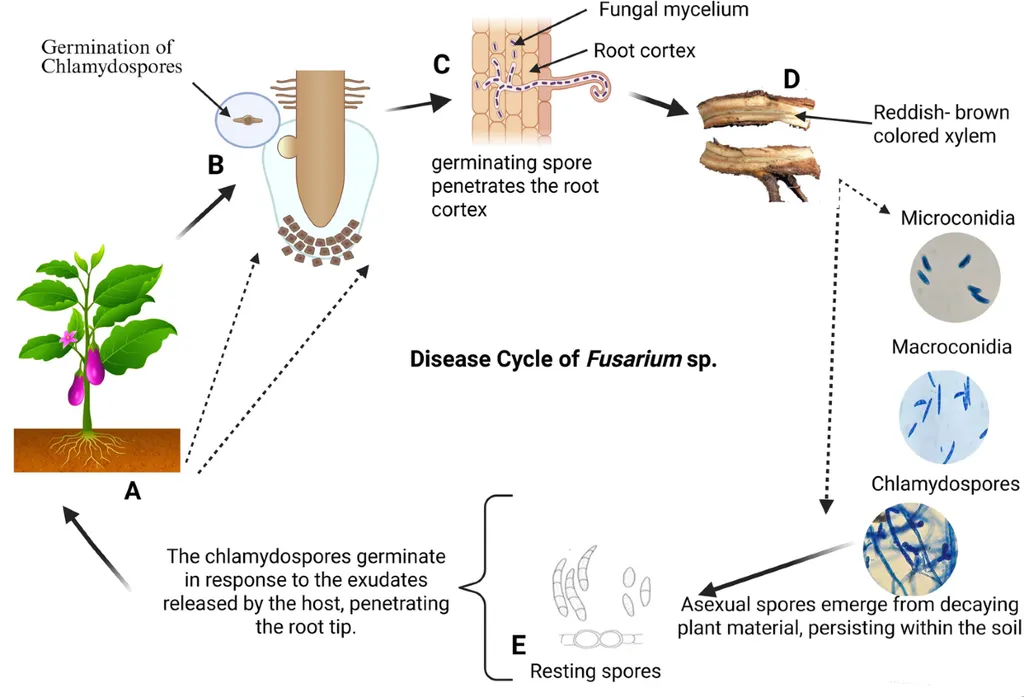
In the relentless pursuit of understanding the intricate dance between plants and their microbial partners, researchers have uncovered a significant shift in the rhizosphere microbiome of plants afflicted by Fusarium wilt. This discovery, published in *Nature Communications*, could reshape our approach to combating this devastating plant disease and open new avenues for sustainable agriculture.
Fusarium wilt, a soil-borne fungal disease, has long been a bane for farmers, causing significant crop losses worldwide. The disease disrupts the plant’s vascular system, leading to wilting and eventual death. However, the plant’s rhizosphere—the soil region influenced by root secretions—harbors a complex community of microorganisms that play a crucial role in plant health.
A team of researchers, led by Lv Su from the College of Resources and Environmental Sciences at Nanjing Agricultural University, conducted a meta-analysis and comprehensive studies to decipher the general variation in the rhizosphere microbiome of Fusarium wilt plants. Their findings revealed that Fusarium infection consistently alters the bacterial community composition in the rhizosphere.
“The rhizosphere microbiomes of Fusarium wilt plants are characterized by the enrichment of Flavobacterium, gene cassettes involved in antioxidant functions related to sulfur metabolism, and the root-secreted tocopherol acetate,” explained Lv Su. This enrichment suggests that these bacteria are not just passive inhabitants but active participants in the plant’s response to the disease.
The researchers isolated an antagonistic strain of Flavobacterium anhuiense from the diseased tomato rhizosphere. They found that the growth of F. anhuiense and the expression of genes related to carbohydrate metabolism in this strain were significantly stimulated by tocopherol acetate. Moreover, the inhibitory effect of F. anhuiense against Fusarium oxysporum and the population enhancement of F. anhuiense by tocopherol acetate were confirmed in planta.
This research sheds light on the key principles governing the assembly mechanism of the microbiome in the Fusarium wilt plants’ rhizosphere. Understanding these principles could lead to the development of novel biocontrol strategies, potentially reducing the reliance on chemical fungicides and promoting more sustainable agricultural practices.
The commercial implications of this research are substantial. By harnessing the power of beneficial microbes, farmers could enhance crop resilience to Fusarium wilt, leading to increased yields and reduced losses. This could be particularly impactful in regions where Fusarium wilt is endemic, providing a much-needed boost to local economies and food security.
As we stand on the brink of a new era in agriculture, driven by technological advancements and a deeper understanding of ecological interactions, this research serves as a testament to the potential of microbiome engineering. It offers a glimpse into a future where crops are not just grown but nurtured in symbiosis with their microbial partners, paving the way for a more sustainable and productive agricultural landscape.
The findings, published in *Nature Communications* and led by Lv Su from the College of Resources and Environmental Sciences at Nanjing Agricultural University, mark a significant step forward in our quest to understand and harness the power of the rhizosphere microbiome. As we continue to unravel the complexities of these microbial communities, the possibilities for innovation in agriculture are boundless.