
In the heart of agricultural innovation, a groundbreaking study is shedding light on how rice, one of the world’s most vital crops, responds to low light conditions. Published in *Discover Plants*, the research led by Pragati Sahu from the Department of Genetics and Plant Breeding at Siksha ‘O’ Anusandhan Deemed to be University, delves into the intricate dance between light availability, photoperiod sensitivity, and micronutrient dynamics in rice (Oryza sativa L.).
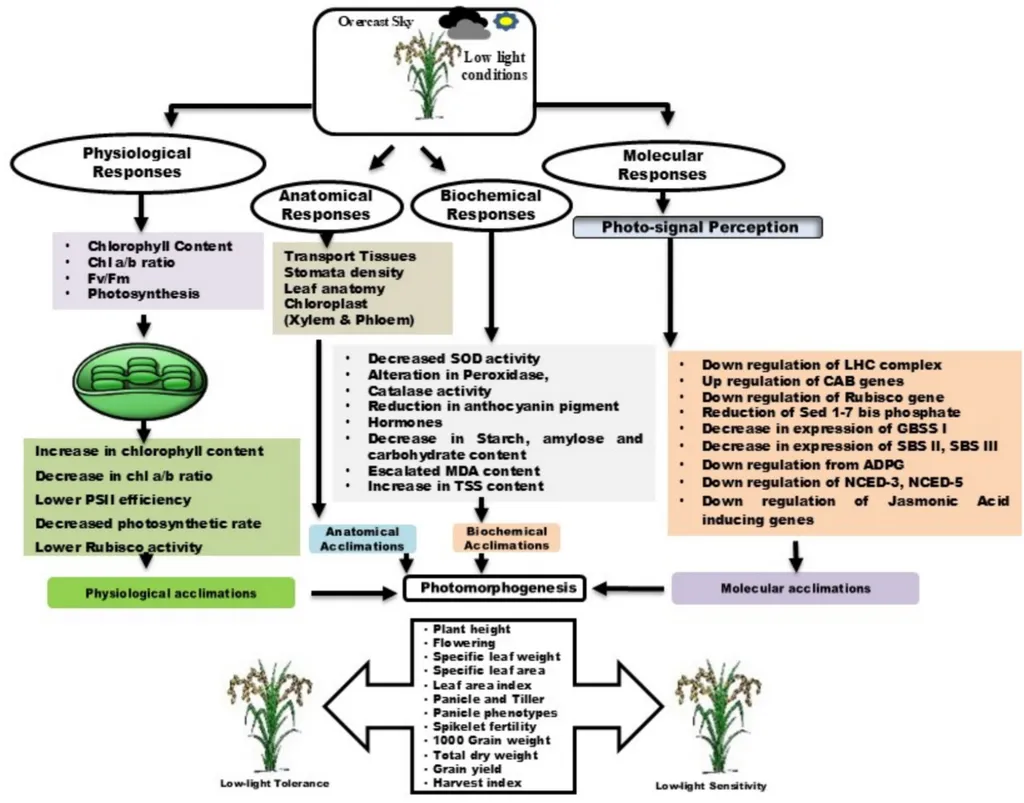
Rice, a staple food for over half of the world’s population, is particularly sensitive to suboptimal illumination. Low light (LL) stress, often caused by prolonged cloud cover, canopy shading, or high planting density, impairs photosynthetic efficiency and disrupts carbon assimilation, ultimately limiting yield potential. The study synthesizes advances in understanding the morphological, physiological, metabolic, and molecular responses of rice to LL stress, providing a comprehensive overview of the challenges and potential solutions.
The research reveals that low light triggers extensive transcriptional reprogramming in rice. This includes changes in light-harvesting complexes, circadian and photoperiodic gene networks, carbohydrate metabolism, hormonal crosstalk, and micronutrient-responsive pathways. “Understanding these molecular mechanisms is crucial for developing strategies to mitigate the impact of low light stress on rice yields,” says Sahu.
One of the most promising aspects of this research is its potential to inform breeding programs aimed at developing low light-tolerant and photoperiod-flexible rice genotypes. By enhancing our understanding of the genetic and molecular basis of low light tolerance, scientists can pave the way for rice varieties that thrive in a wider range of environmental conditions. This could be a game-changer for farmers in regions with variable light conditions, ultimately contributing to global food security.
Moreover, the study highlights the importance of optimizing canopy management to maximize light interception. This could lead to more efficient use of agricultural resources and improved crop yields. “Integrative multi-omics approaches are beginning to unravel the regulatory networks and adaptive mechanisms underpinning low light tolerance,” Sahu explains. “This knowledge can be leveraged to develop targeted interventions that enhance rice productivity and quality.”
The commercial implications of this research are significant. Rice is a major commodity in global trade, and any improvement in yield and quality can have far-reaching economic benefits. By addressing critical research gaps, particularly in genotype-by-environment-by-management interactions, this work could revolutionize rice farming practices and ensure stable production even in light-limited environments.
As we face the challenges of a changing climate and growing population, understanding and mitigating the impact of low light stress on rice is more important than ever. This research not only advances our scientific knowledge but also offers practical solutions that can be implemented in the field. With continued investment and innovation, the future of rice farming looks brighter than ever.