
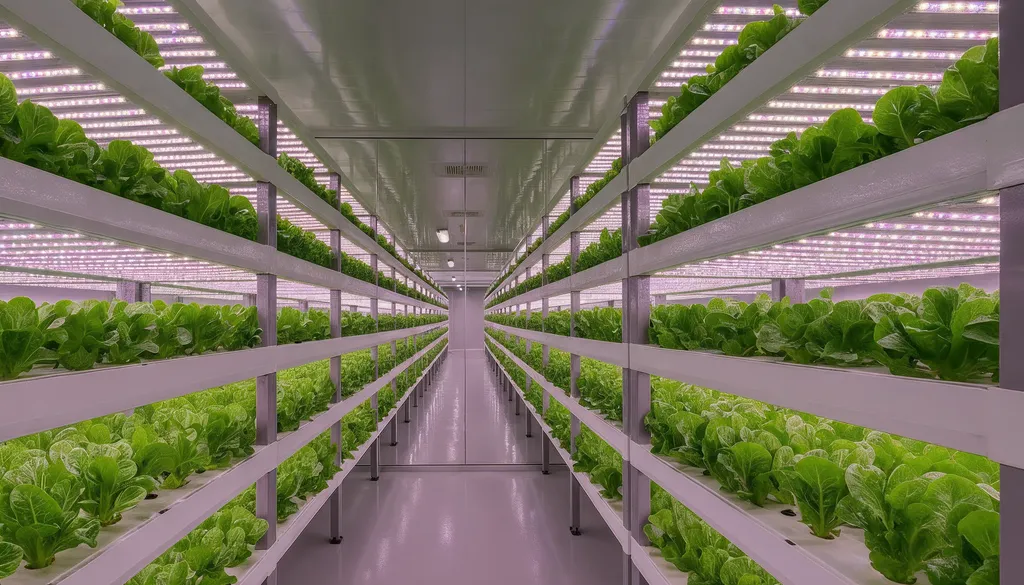
In the rapidly evolving world of vertical farming, researchers are constantly seeking ways to optimize plant growth while minimizing energy consumption. A recent study published in *Frontiers in Plant Science* offers a promising solution: continuous lighting (CL). The research, led by Diego Núñez Ocaña from Wageningen University & Research, demonstrates that CL can enhance lettuce growth and improve energy-use efficiency, potentially revolutionizing the way we approach controlled environment agriculture.
The study focused on two lettuce cultivars, ‘Jagger’ and ‘Danstar,’ and compared their growth under continuous lighting with that under an 18-hour photoperiod, both at the same daily light integral. The results were striking. Under continuous lighting, the leaf area growth of ‘Jagger’ increased by 10%, leading to improved light interception. While ‘Danstar’ showed no significant change in light interception, both cultivars exhibited shifts in carbohydrate metabolism, with sucrose decreasing and starch accumulating. This metabolic shift is a key indicator of improved light use efficiency (LUE), which increased by 7 to 11% under continuous lighting.
The practical implications of these findings are substantial. Fresh and dry mass increased by 23% in ‘Jagger’ and by 6% and 14% in ‘Danstar,’ respectively. “This growth enhancement is a game-changer for vertical farming,” says Núñez Ocaña. “It means we can produce more with the same energy input, which is crucial for reducing operational costs and improving sustainability.”
One of the most compelling aspects of this research is its potential to reduce energy costs and lighting investment in vertical farming. The study found that continuous lighting required the same energy input as the 18-hour photoperiod, but due to the enhanced growth, it resulted in a 16 to 18% higher energy-use efficiency (EUE). This efficiency gain could translate into significant savings for commercial growers, making vertical farming a more viable and profitable venture.
Moreover, the visual quality of the lettuce remained unaffected under continuous lighting, with no signs of tip-burn or bolting. This is a critical factor for commercial growers, as it ensures that the produce meets market standards and consumer expectations.
The findings of this study open up new avenues for research and development in the field of controlled environment agriculture. As Núñez Ocaña notes, “This is just the beginning. We need to explore how these findings can be applied to other crops and under different growing conditions.” Future research could focus on optimizing lighting strategies for a wider range of crops, further enhancing the sustainability and profitability of vertical farming.
In conclusion, this research offers a promising strategy to improve lettuce growth and energy-use efficiency in vertical farming. By adopting continuous lighting, growers can potentially increase their yields and reduce their energy costs, making vertical farming a more sustainable and economically viable option. As the agriculture sector continues to evolve, such innovations will be crucial in meeting the growing demand for food while minimizing environmental impact.