
In the intricate world of soil-dwelling fungi, a newly published study is shedding light on a unique enzyme family that could hold the key to more effective biological pest control and improved agricultural sustainability. The research, led by Naike Kruhler from the Department of Molecular Sciences at the Swedish University of Agricultural Sciences, focuses on the fungus Clonostachys rosea and its unusually high number of cellobiose dehydrogenase (CDH) genes, published in *Microbiology Spectrum*.
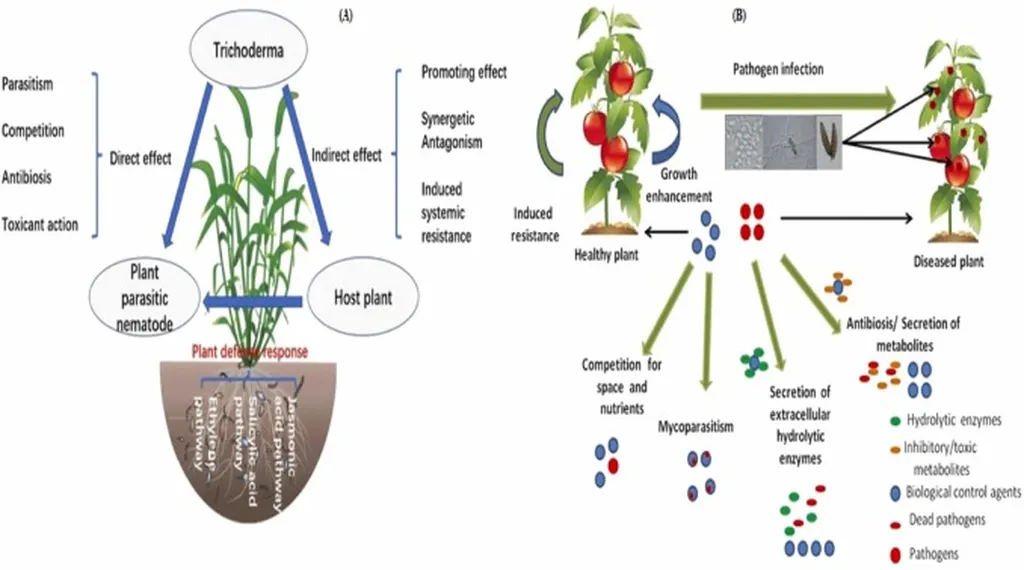
Clonostachys rosea is a versatile fungus with a triple threat lifestyle: it colonizes living plants, decomposes organic material in soil, and acts as a necrotrophic mycoparasite, attacking and killing other fungi or nematodes. This makes it a promising candidate for biological pest control. The study reveals that C. rosea possesses a surprisingly high number of genes coding for CDHs compared to other fungi like Neurospora crassa and Trichoderma reesei, which are known for their reduced or absent CDH gene content.
CDHs are extracellular enzymes typically associated with wood-degrading fungi, playing a role in the breakdown of cellulose, hemicellulose, and lignin. The research team conducted a phylogenetic analysis of CDH enzymes in C. rosea, identifying six members in the AA3_1 class II and III. Notably, the class II enzymes possess fungal carbohydrate-binding domains (CBM1), which are absent in class III.
“Our structural and functional analysis revealed significant differences in the active site composition between class II and class III CrCDHs,” Kruhler explains. “However, we found no activity in class III enzymes on the tested substrates, which is quite intriguing and warrants further investigation.”
The study also involved mass spectrometry analysis of class II CDHs, confirming the presence of oxidized products consistent with single oxidized oligosaccharides, including glucose, mannose, maltose, cellobiose, lactose, and maltotriose. This finding suggests that these enzymes play a role in the degradation of various complex carbohydrates.
Perhaps the most exciting aspect of this research is its potential commercial impact on the agriculture sector. The functional transcript analysis in C. rosea revealed the activation of all cdh genes during self-recognition, sensing, and contact with the host fungus. The differential expression analysis indicated specific involvement of these CDHs in mycoparasitism, wheat root colonization, and the degradation of simple and complex cellulosic compounds like microcrystalline cellulose and wheat straw.
“This study provides the first characterization of the unusually enriched CDH gene family in Clonostachys rosea,” Kruhler says. “Our findings establish a pioneering framework for understanding CDH diversification and its contribution to different fungal lifestyles, which could pave the way for developing more effective biological control agents and improving agricultural sustainability.”
The research not only advances our understanding of the ecological roles of CDHs but also opens up new avenues for exploring their potential applications in agriculture. As the world seeks more sustainable and eco-friendly solutions to pest control and crop protection, the insights gained from this study could prove invaluable in shaping future developments in the field.