
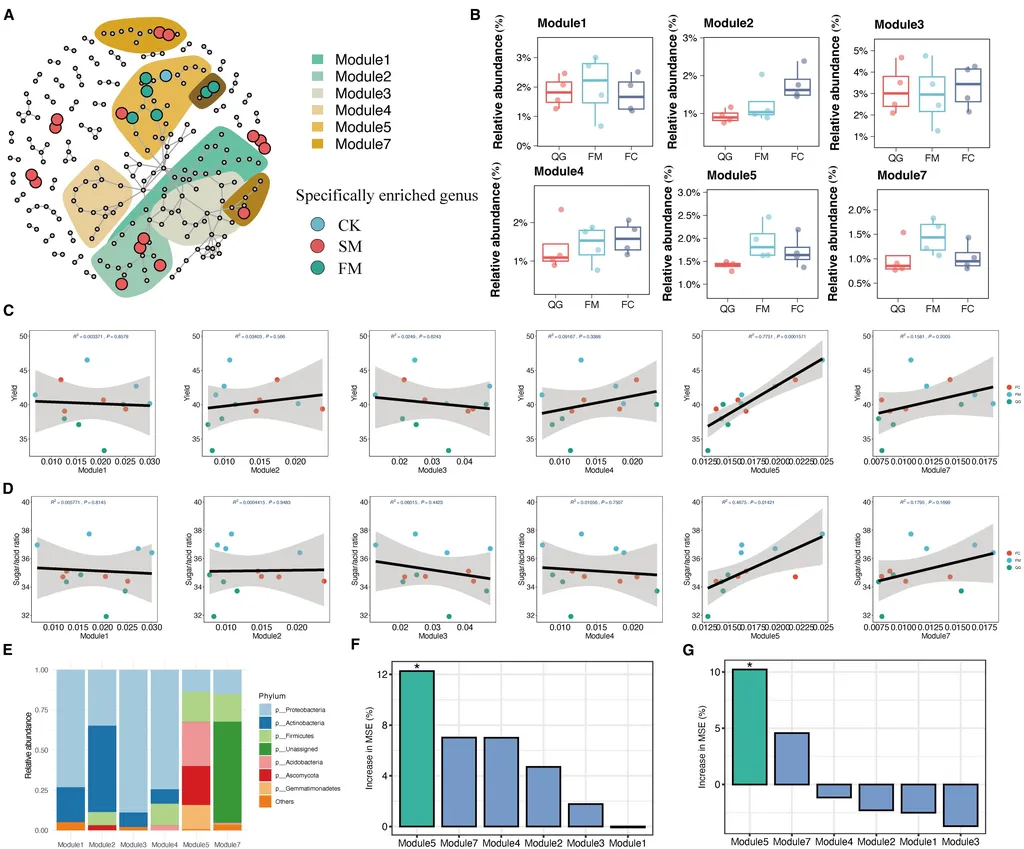
In the quest for sustainable agriculture, scientists are increasingly turning to microbial management as a promising strategy to boost crop performance. A recent study published in *Frontiers in Microbiology* has revealed that targeted microbial applications can significantly enhance the yield and quality of pears by optimizing the microbial communities in both the phyllosphere (the aerial parts of the plant) and the rhizosphere (the root zone). This research, led by Na Luo from the Institute of Environment and Sustainable Development in Agriculture at the Chinese Academy of Agricultural Sciences, offers a novel approach to improving fruit tree productivity and quality.
The study focused on ‘Yuluxiang’ pears, comparing conventional fertilization with two treatments: one involving a soil-applied anti-replant disease agent and another combining the soil agent with a foliar growth-promoting inoculant. The results were striking. The yield increased by up to 60.4% in the treatment that included the soil agent, while key fruit quality parameters such as soluble solids content saw improvements of 17.2% and 16.7% in the respective treatments. These enhancements were closely linked to changes in the microbial communities.
“By applying microbial agents, we were able to restructure the bacterial communities in both the phyllosphere and rhizosphere,” explained Luo. “This restructuring led to the enrichment of beneficial bacteria, such as Actinomycetota in the phyllosphere and Bacillota in the rhizosphere, which played a crucial role in improving fruit quality and yield.”
The study also highlighted the importance of microbial networks. Co-occurrence network analysis showed that microbial applications fostered more complex and cooperative microbial networks, with increased nodes and edges across both compartments. This suggests that a holistic approach to microbiome management can create a more resilient and productive ecosystem for fruit trees.
The commercial implications of this research are substantial. As the agriculture sector seeks sustainable and efficient ways to boost productivity, microbial management offers a promising alternative to traditional chemical fertilizers and pesticides. By leveraging the natural benefits of microbial communities, farmers can enhance crop yields and quality while reducing environmental impact.
“This research demonstrates that an integrated soil and foliar microbiome management strategy can mitigate replant disease constraints and elevate fruit quality,” said Luo. “It provides a practical approach for sustainable orchard production, which is crucial for the future of agriculture.”
The findings from this study could pave the way for further advancements in microbial management strategies across various crops. As researchers continue to explore the intricate relationships between plants and their associated microbiomes, the potential for innovative and sustainable agricultural practices grows. This research not only highlights the importance of microbial communities in agriculture but also offers a blueprint for future developments in the field.