
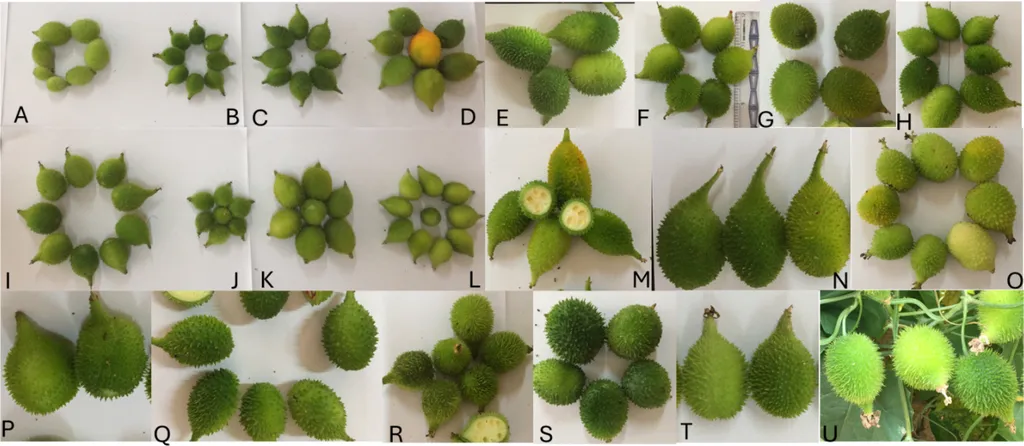
In the heart of Odisha, India, a team of researchers led by Sasmita Priyadarsini Dash from the Department of Vegetable Science at Siksha ‘O’Anusandhan Deemed to be University, has been delving into the genetic diversity of spine gourd (Momordica dioica Roxb.), an underutilized vegetable with significant potential. Their findings, recently published in ‘Cogent Food & Agriculture’, could pave the way for improved genetic enhancement and commercial opportunities in the agriculture sector.
The study assessed 17 landraces of spine gourd, alongside a check genotype, to identify promising genotypes for future breeding programs. The results were promising, with high genotypic (99.53%) and phenotypic (97.69%) coefficients of variation, indicating substantial genetic diversity with minimal environmental influence. This variability is a goldmine for breeders, as it provides a broad genetic base for developing improved cultivars.
The research identified key traits that strongly influence fruit yield per plant, such as vine length, internodal length, fruit size, and single fruit weight. “Understanding these trait correlations is crucial for breeders,” Dash explains. “It allows us to focus our efforts on the most impactful traits, accelerating the breeding process and improving the efficiency of genetic gain.”
Multivariate cluster analysis grouped the genotypes into four distinct clusters, with one cluster (cluster IV) standing out due to its superior mean performance for several traits. This cluster harbored the largest number of genotypes (n=11), suggesting it could be a valuable resource for breeders seeking to enhance yield and other important traits.
The study also employed ISSR (Inter-Simple Sequence Repeat) markers to analyze molecular diversity. The results revealed a moderate level of genetic variation among the landraces, with similarity coefficients ranging from approximately 0.75 to 1.00. The ISSR primers generated polymorphic bands, and the observed polymorphic information content (PIC) values indicated moderate to good marker informativeness. This confirms the suitability of ISSR markers for diversity analysis in spine gourd and provides a robust tool for future genetic studies.
The UPGMA (Unweighted Pair Group Method with Arithmetic Mean) dendrogram based on ISSR data grouped the landraces into distinct clusters, identifying several accessions that were genetically distant from the main groups. These genetically divergent genotypes could be valuable for hybridization and recombination breeding, further expanding the genetic base of spine gourd.
The commercial implications of this research are significant. By identifying promising genotypes and understanding key trait correlations, breeders can develop improved spine gourd cultivars with higher yields, better adaptability, and enhanced market appeal. This could open up new opportunities for farmers, particularly in regions where spine gourd is underutilized, and contribute to food security and economic development.
Moreover, the insights gained from this study could extend beyond spine gourd. The methodologies and approaches employed could be applied to other underutilized crops, driving innovation and genetic improvement in the broader agriculture sector.
As the world grapples with the challenges of climate change, food security, and sustainable agriculture, research like this is more important than ever. By harnessing the power of genetic diversity and advanced breeding techniques, we can develop resilient, high-yielding crops that meet the needs of a growing global population.
In the words of Dash, “This research is just the beginning. The genetic diversity we’ve uncovered in spine gourd is a treasure trove of potential, and we’re excited to see how it will shape the future of this underutilized crop.” With continued investment and innovation, the future of spine gourd—and the agriculture sector as a whole—looks bright.