
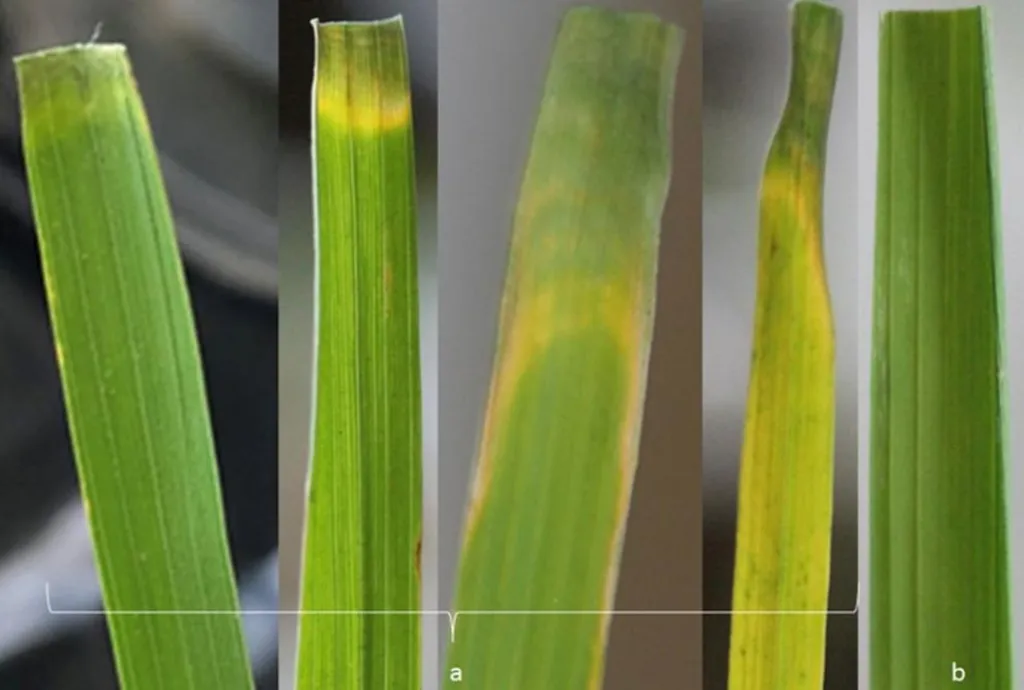
In the ongoing battle against rice bacterial leaf blight, a destructive disease caused by Xanthomonas oryzae pv. oryzae (Xoo), scientists have discovered a promising ally in an unlikely candidate: Pantoea ananatis. This bacterium, known to play both friend and foe in the rice-Xoo pathosystem, has been found to exhibit potent biocontrol properties, offering a potential game-changer for rice farmers worldwide.
A recent study published in *Frontiers in Microbiology* sheds light on the mechanism by which P. ananatis suppresses Xoo, providing valuable insights for disease management strategies. The research, led by Ye Tian from the State Key Laboratory of Rice Biology and Breeding at Zhejiang University, identified 18 strains of P. ananatis (ZJU1-ZJU18) that demonstrated plant growth-promoting traits, including phosphate solubilization, siderophore production, and indole-3-acetic acid synthesis.
The study revealed that these strains not only inhibited rice bacterial leaf blight symptoms but also significantly reduced Xoo colonization on rice leaves. “P. ananatis suppressed Xoo via nutrient competition, dominating co-culture systems and reducing Xoo colonization by up to 99%,” Tian explained. This nutrient competition is a critical factor in the biocontrol mechanism, as P. ananatis outcompetes Xoo for resources, effectively starving the pathogen and preventing its proliferation.
Moreover, the research found that Xoo infection enhanced P. ananatis colonization, likely by modifying the leaf microenvironment. This symbiotic relationship could be harnessed to develop more effective biocontrol strategies, potentially reducing the need for chemical pesticides and promoting sustainable agriculture.
The study also highlighted the impact of P. ananatis on the microbial community structure in rice leaves. “P. ananatis altered the structure and diversity of the microbial community, reducing the abundance of Xanthomonas species,” Tian noted. This finding suggests that P. ananatis could be used to reshape the microbial ecosystem in rice leaves, creating an environment less conducive to pathogen growth.
The commercial implications of this research are substantial. Rice is a staple food for more than half of the world’s population, and bacterial leaf blight can cause significant yield losses. The development of biocontrol agents based on P. ananatis could provide a cost-effective and environmentally friendly solution for rice farmers, enhancing crop yields and food security.
As the agriculture sector continues to grapple with the challenges of climate change, pest resistance, and environmental degradation, the discovery of natural biocontrol agents like P. ananatis offers a ray of hope. Future research could focus on optimizing the application of P. ananatis in the field, exploring its potential in combination with other biocontrol agents, and investigating its efficacy against other crop pathogens.
In the words of Ye Tian, “This study opens up new avenues for the development of sustainable and effective disease management strategies in rice cultivation.” As we stand on the brink of a new era in agricultural biotechnology, the humble P. ananatis may well prove to be a silent guardian of our crops, ensuring food security for generations to come.